
Standing amongst the narrow display racks and shelves of Pickings and Parry one of the first things that strikes me is the smell. Lanolin. Hardwood. Aftershave. Sunlight warming dust. Beyond mens- and womenswear, the store boasts a barber, the wicker-snick of scissors snipping below the low conversations of perusing couples and shop workers assisting with sizing. It’s a warm day, bright outside, the sidewalk heating as the morning ages. Pedestrians pass the windows, coffees in hand, tote bags over shoulders, this part of Gertrude Street still possessed with a bohemian mien native to this conjoining of Fitzroy and Collingwood where cafes and eateries almost outnumber people and trams ding-rattle up and down Victoria Parade. But this scene is not the reason for my visit, not the why. I have a purpose.
Brands cluster. Barbour beside Heimat knits. Knickerbocker mixed with Indigofera, Nigel Cabourn, Sugar Cane, and Blue Blue Japan. Reflection glint and fisheye in KameManNen and Oliver Peoples glasses and a small selection of Blue de Chauffe bags suggest a careful curation of products which, in turn, announces an aesthetic channelling a craftsmanship and quality know to yesteryear. The store says, “To step in here is to step into another time and place, pieces of which you can take with you, back into your world, your lives, carry them like talismans.” I’m not here for that either. Buying of the new isn’t my intention. I’m here for something aged, pre-loved, already inscribed with someone else’s story.
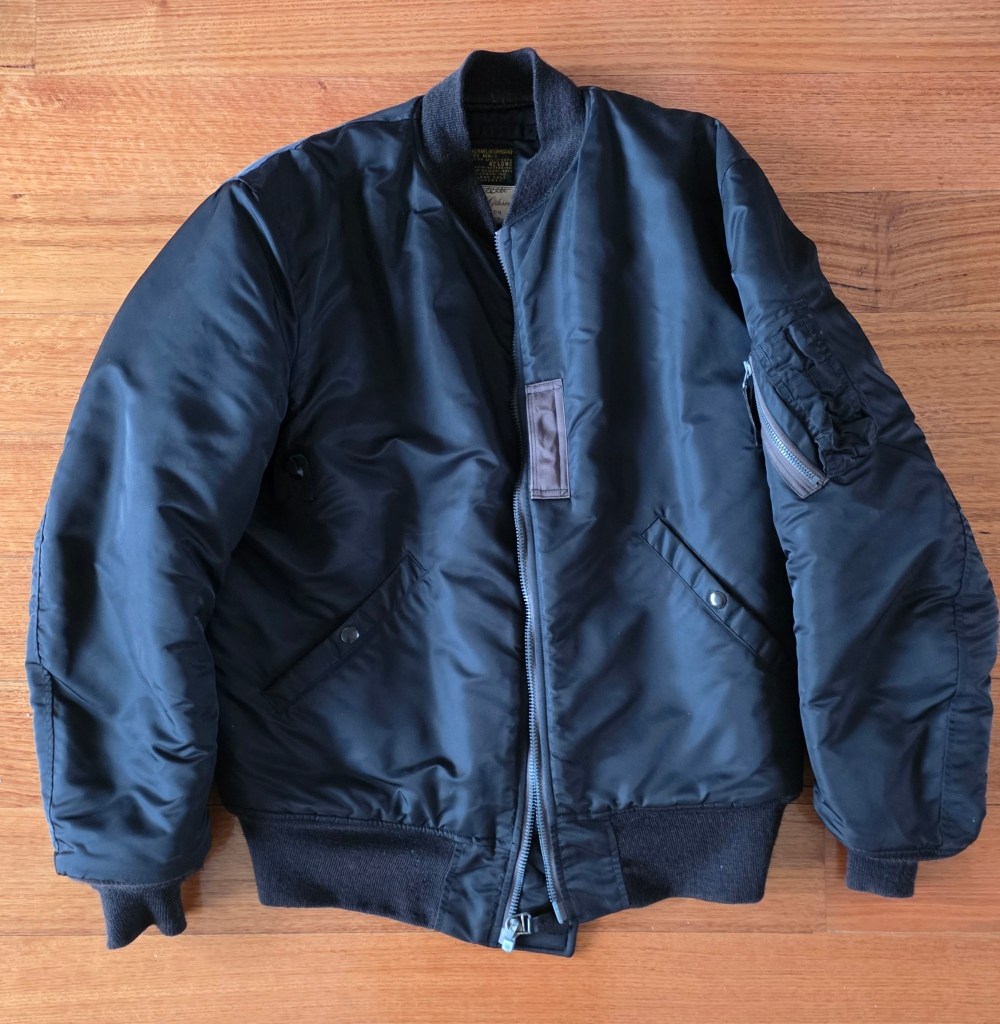
My MA-1 after winter wears and seasonal hibernation in the wardrobe.
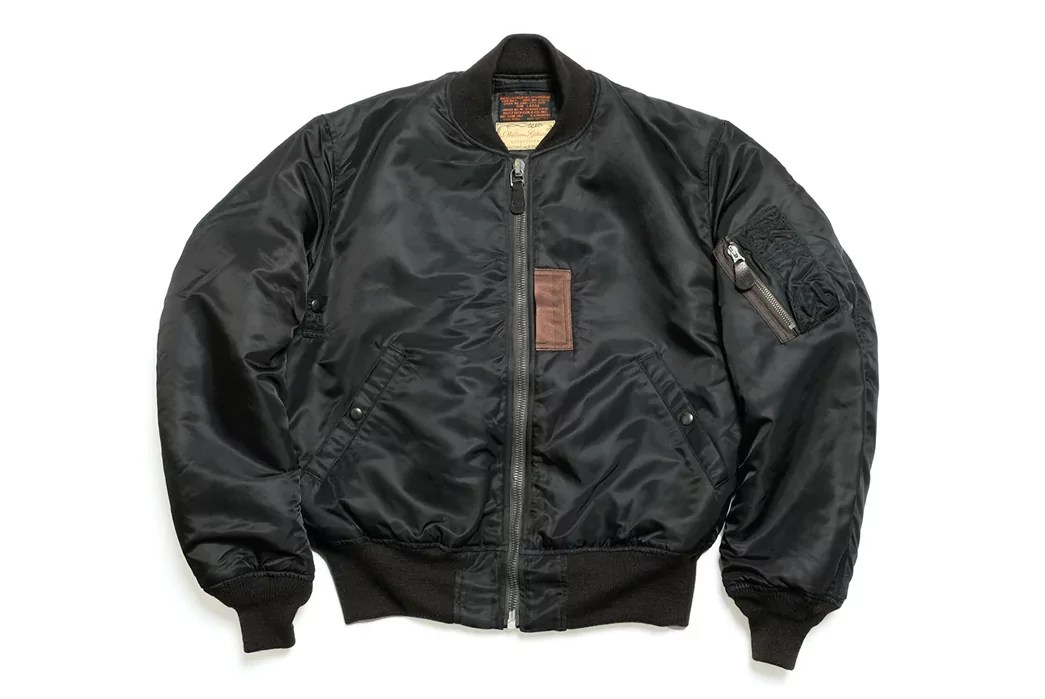
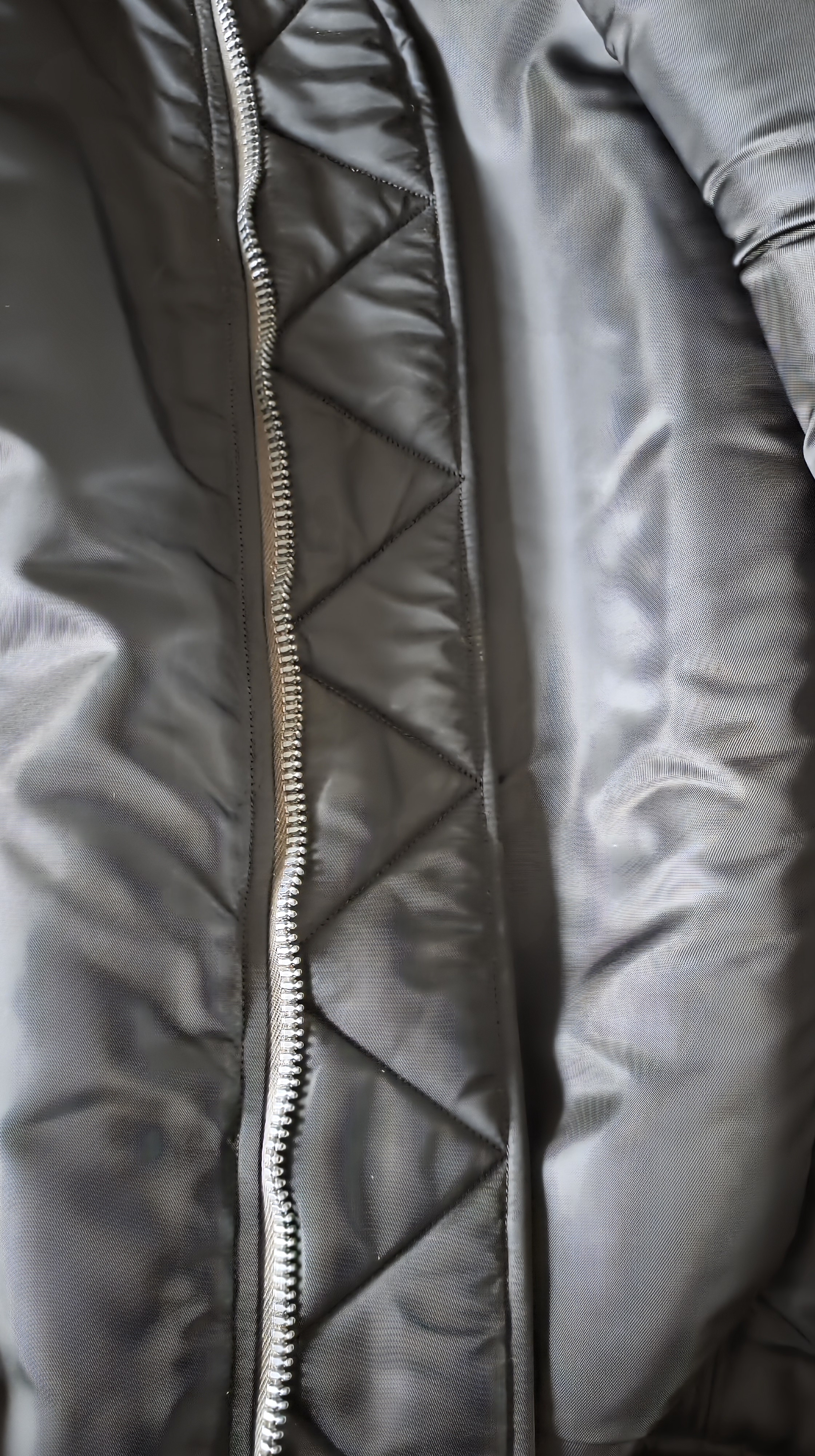
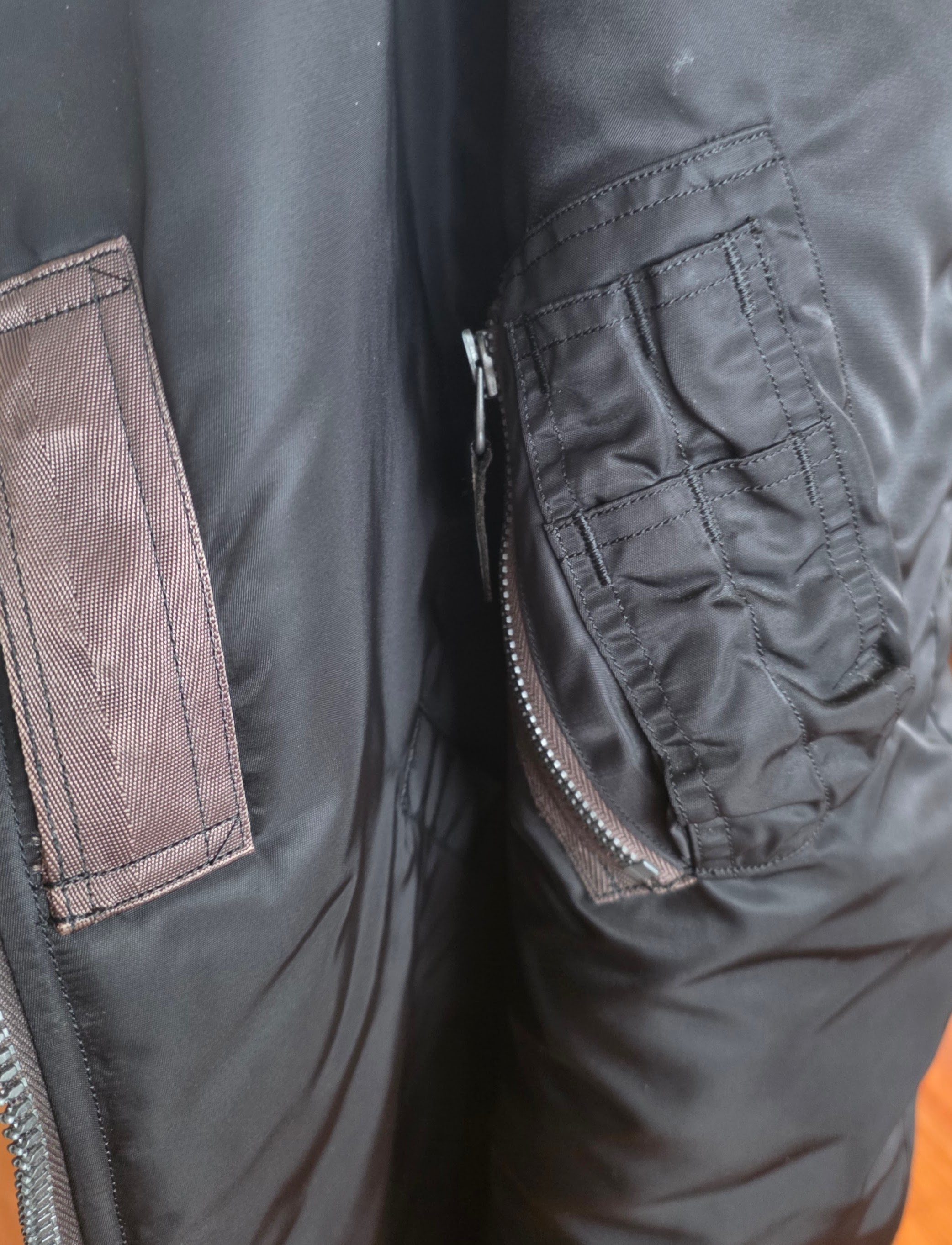
The Buzz Rickson x William Gisbon MA-1 flight jacket hangs in the changing room, something almost organic in the puckered wrinkles of the black nylon. Thick, matte zippers with leather pull tabs, their teeth industrial wide and flat. Brownish black worsted wool at the collar, cuffs, and waist. I shrug it on. An initial impression in one of weight. It is heavy. Solid. More like armour than anything I’ve ever worn, the mass of it recalls its military inception and the fact that it was designed to keep pilots warm in their cockpits. Performing a once over, zip it up, pat its chest, play with the zippers, feel it slither and settle with the movements, and notice the hole in one of the cuffs: the only real sign of previous wear. Even this imperfection, though, fails to detract from what is, in streetwear parlance, a grail. If anything, its adds to it the thing’s aura which one might declare as a form of wabi-sabi. It isn’t a museum piece or archival object. It has been worn and loved and used by its current owner who is seeking to sell it on, which is why I’m here and I leave with the jacket in a plain paper bag.
A normal commercial scene, right?
Well, maybe, but what is curious about it is the fact that until 2004, the black MA-1 flight jacket, of which (now) my jacket was a reproduction, did not exist.
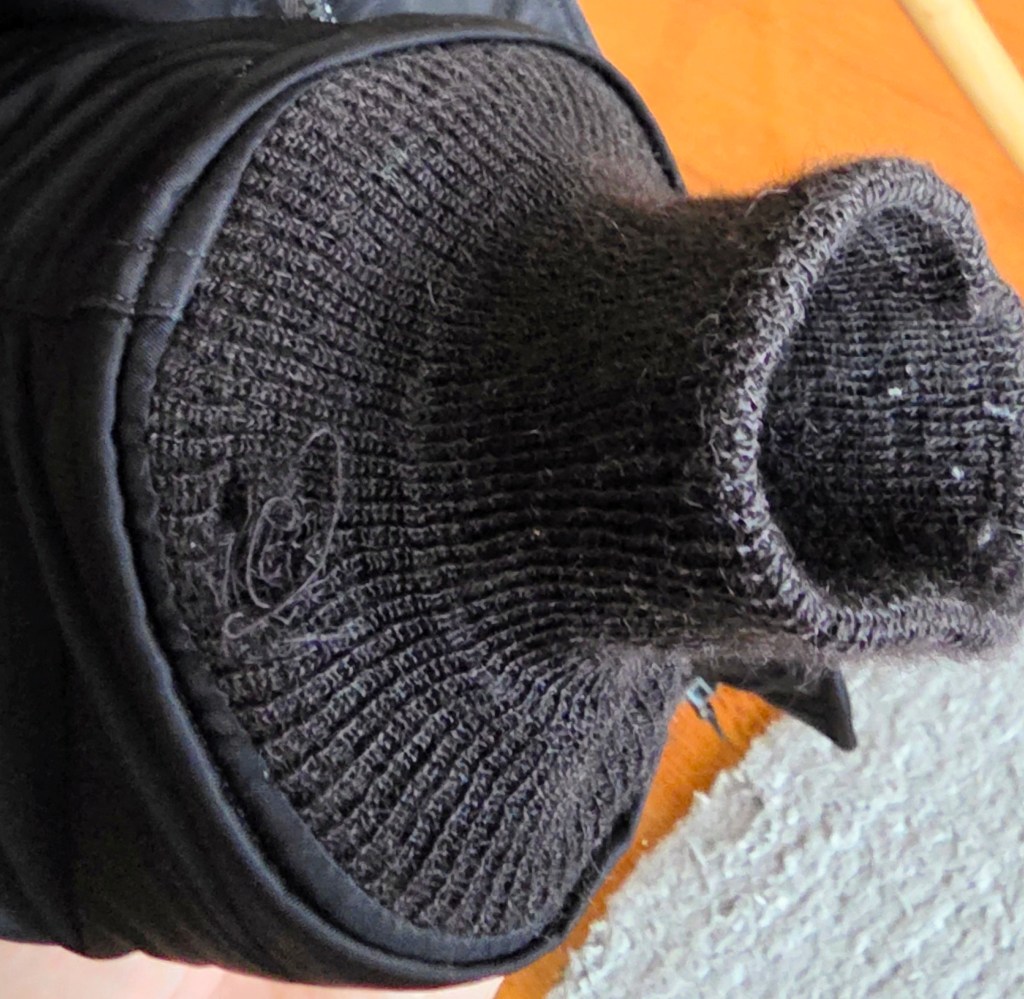
The only sign of previous wear.
A little hole in the two-ply 100% worsted wool knit cuff.
Deep breath, deep dive …
Last week I made several mentions Pattern Recognition (2003) and its description of the Buzz Rickson MA-1 flight jacket in black. There are several reasons that this jacket is fascinating, both in the text and outside it, the most intriguing of which is the fact that when Gibson wrote his text the jacket did not and had not ever existed in black. This fact, however, was soon to change.
In an interview with Heddles, Gibson relates the moment that fiction became fact, stating that:
“I received a baffled letter from Buzz Rickson, asking why I’d put their name on something they’d never made. I explained it as best I could, apologetically, and they told me they really wanted to make that jacket. They’d been getting letters from people, asking where they could buy one. So the black MA-1 was our first jacket. I had them make it a few inches longer than the original pattern, though, because most MA-1s are a little too short for me” (Schuck 2015)1.
On its own, this movement from imaginary object to manufactured product isn’t that strange or shocking of an event, especially given Gibson’s avowed favour for Japanese denim and workwear. However, the very fact that the jacket is not/is real while acting as Pattern Recognition‘s most totemic symbol of both coolness and the market’s implicit need to commodify the cool requires some attention.
In the text, Cayce, our protagonist, is a coolhunter. Her job is to seek out the very abstract, nebulous, and ephemeral manifestations of “cool” and signpost them for companies to translate it into something saleable. But cool isn’t simply things, it is the relationship between things and people, things and society, things and the world. We might say that cool has both an aesthetic and the ethics, and that, accepting this, Cayce’s position as a coolhunter who is deeply allergic to the end-stage branding of companies and products is the dialogical lens through which we might read the text and its core totem.
In “The Brand as Cognitive Map in William Gibson’s Pattern Recognition” (2009), Lee Konstantinou summarises his research into the coolhunters and brand logic as a operationalised relationship where “coolhunters” help their corporate clients commodify the aesthetic, ethical, and social values that shapes consumer behaviour”2.
Ok, but why should we care?
Well, if we allow that the story world presented in Pattern Recognition is not too dissimilar from our own, the degree to which corporate interests and/or market forces are seen to colonise “aesthetic, ethical, and social values”–i.e. the basic ways we navigate everyday existence–is of great importance for many of the reasons I outlined last week. Indeed, the overarching takeaway of Konstantinou’s analysis of branding process is that “brands are systems of meaning, value and self-identification”3. What prompts us to choose Adidas over Nike? Asics over Brooks? Why might we fill a drawer with Uniqlo, but not Target? Thrifted clothes over the newly made? Sometimes such choices are motivated by assumptions about quality or a gravitation toward buying local product. At other times, one might want to be associated with a brand’s stated ethos or concerns over waste. Clean Up states that over “200,000 tonnes of clothing end up in Australian landfills each year”4 which suggests that decision to eschew fast-fashion in favour of its more traditional counterpart might be guided by combination of ethical, environmental, and political impulses. That said, we should be careful of ascribing altruism to such a choice as there is evidence to suggest that “[we] get mad when Nike exploits Indonesian workers not because we love Indonesian workers but because we love Nike or identify with its professed values”5. In other words, because it attacks our identity, it slashes at the story we tell ourselves about our selves–what we stand for, what we like, what we’ll tolerate, what we aspire towards, etc.
Thus, we should care because the socio-commercial world we inhabit and the “prearranged menu of lifestyle choices”6 it provides because if Pattern Recognition is anything to go by this world is something of a downer because amidst its overwhelming abundance of commodified choice what it lacks is authenticity. Two examples best illustrate this.
- Within the bowels of a shopping centre, Cayce feels that Tommy Hilfiger is the best/worst symptom to diagnose this lack as it is a “diluted tincture of Ralph Lauren, who had himself diluted the glory days of Brooks Brothers, who themselves had stepped on the product of Jermyn Street and Savile Row”7.
- In her travels, Cayce meets a woman whose passion is making hats but whose day job is a form of subliminal marketing: chatting to/up marks in bars and clubs while throwing in commentary about her employer’s products. The result of this profession, though, leaves her feeling like she is “devaluing something. In other. In myself. And I’m starting to distrust the most casual exchange.”8
What we achieve is these two premises are combined into a single socio-economic equation is that the overbearing and undercutting nature of the market transposes originality to facsimile while coopting the interpersonal to broaden advertising opportunities. Terms that spring to mind: debasing, emptying out, instrumentalisation of creativity and humanity. To some, this describes the basic fact of life within global capital; to others, its amounts to a anti-human, consumerist hellscape. In either case, it is that reality Konstantinou delineates when he argues that:
“Brands, personified through such corporate mascots as the Pilsbury Doughboy and Bibendum, seem to be locked with us in a war for sovereignty over our minds and our wallets. Sometimes, depending on whom you ask, we beat up the doughboy; sometimes, instead, the Michelin Man beats us”9.
Maybe this is a long bow to draw. Maybe it isn’t. Common wisdom holds that the only power consumers potential hold is to “vote” with their wallets, giving custom to one brand while boycotting another, even though, for the sake of illustration, two hypothetical sportswear companies employ the same exploitative workplace practices, in the same city, sometimes in same factory.
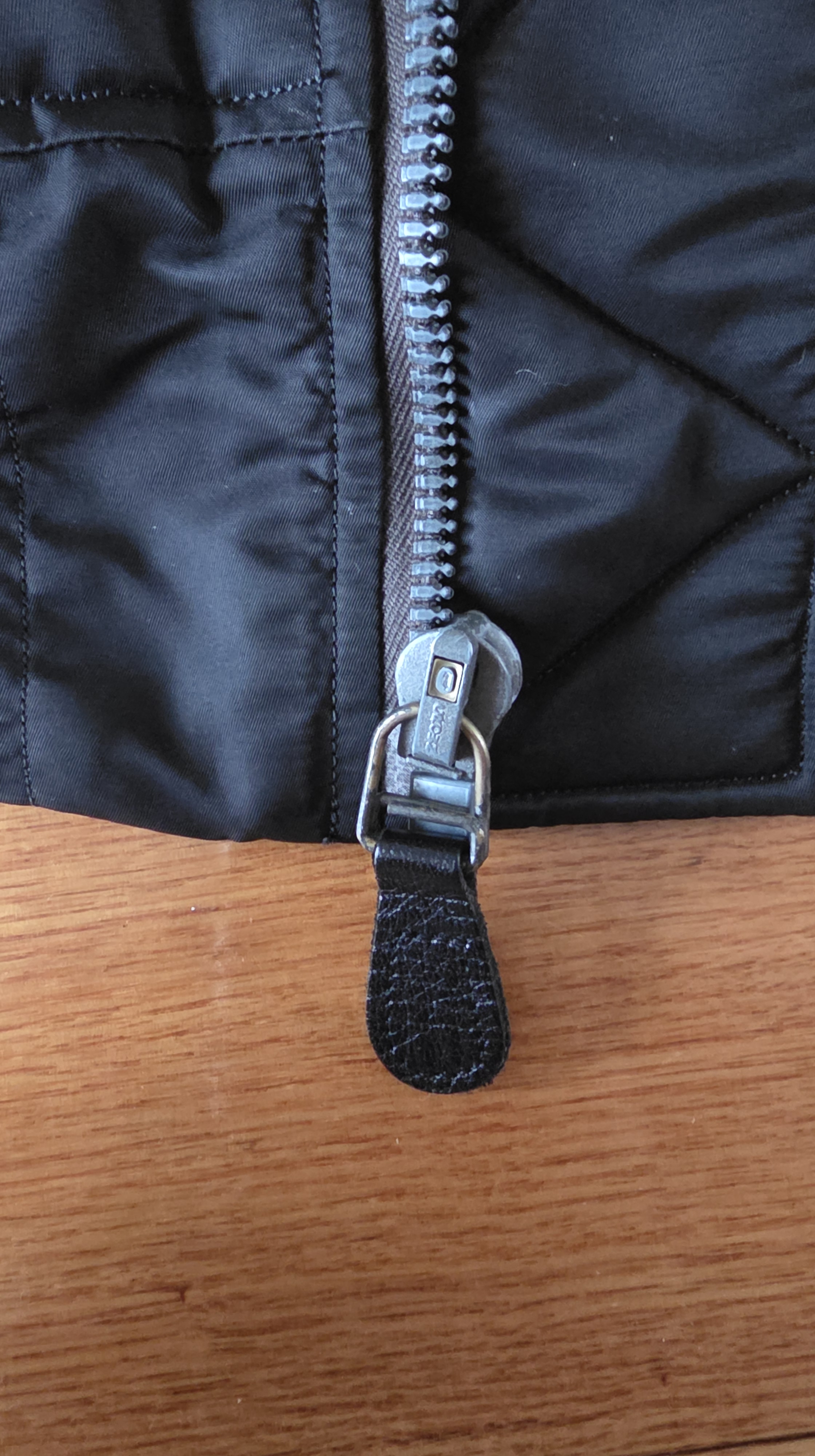
Cayce’s strategy for coping with and navigating through this reality is characterised by the Buzz Rickson MA-1. She removes the labels of everything she owns, removing the fingerprints of branded creation, almost exclusively wearing black. On top of this minimalising, the MA-1 acts as her ethical-philosophical paradigm. She understands it a “fanatical museum-grade replica” and “as purely functional and iconic garment as the previous century produced” that has been made by “Japanese obsessives driven by passions having nothing at all to do with anything remotely like fashion”10. Note the how “replica” is not a synonym for simulacra, “purely functional” and being “iconic” are conflated, and the motivations governing its conception exist beyond or outside of fashion. It is a replica better than the original. This inversion of what we might expect becomes synonymous with the sort of places and things Cayce seeks out wherever she exists. In Tokyo, she notices that her bacon is “crisp and very flat” like it had been “ironed” and that this is a function of how Japanese hotels “interpret Western breakfasts the way Rickson’s makers interpret the MA-1”11. It recalls the original but seems truer, more authentic because of the obsessive, human focus behind its making. This is the power of the MA-1: it is authentically cool because it has been made not to be cool, not to enter into the logic of fashion, because it is more real than the real object it first sought to mimic.
… resurface from the depths, sucking in a lungful of oxygen.
This is the story Pattern Recognition weaves into the very fabric of its MA-1, and this story conforms to Gibson own predilections when it comes to the clothes he wears. In terms of fashion’s meta-ethics, he argues:
“It’s not about exclusivity, for me, or about *hyper-coded* exclusivity, or any kind of clubbiness. I’m embarrassed if I think anyone knows exactly what I paid for something, or even where I got it. I want what I’m wearing to feel good on, wear well, and be extremely functional.”12
And this mindset is explicitly geared against the macro-economic structure of fast fashion where:
“With J.Crew, say, or Urban Outfitters, claims to authenticity tangle bizarrely with economies of scale, and we see “value-mining”, hollowing out the individual unit for maximum profit. T-shirt weaves are conceived to require less cotton (“it looks authentically worn”). That’s when you get into seriously sad simulacra territory.”13
Not that authenticity, as a category instilling value, is an overarching dictate for Gibson. Declaring that he would rather have “well-designed, well-constructed, long-lasting”, a desire that carries into the Buzz Rickson x William Gibson collection where, in his words, the “finishing on a Rickson reproduction is exponentially superior to the finishing on most of the originals, and I’d much rather have a brand-new exact copy that’s more carefully assembled”14.
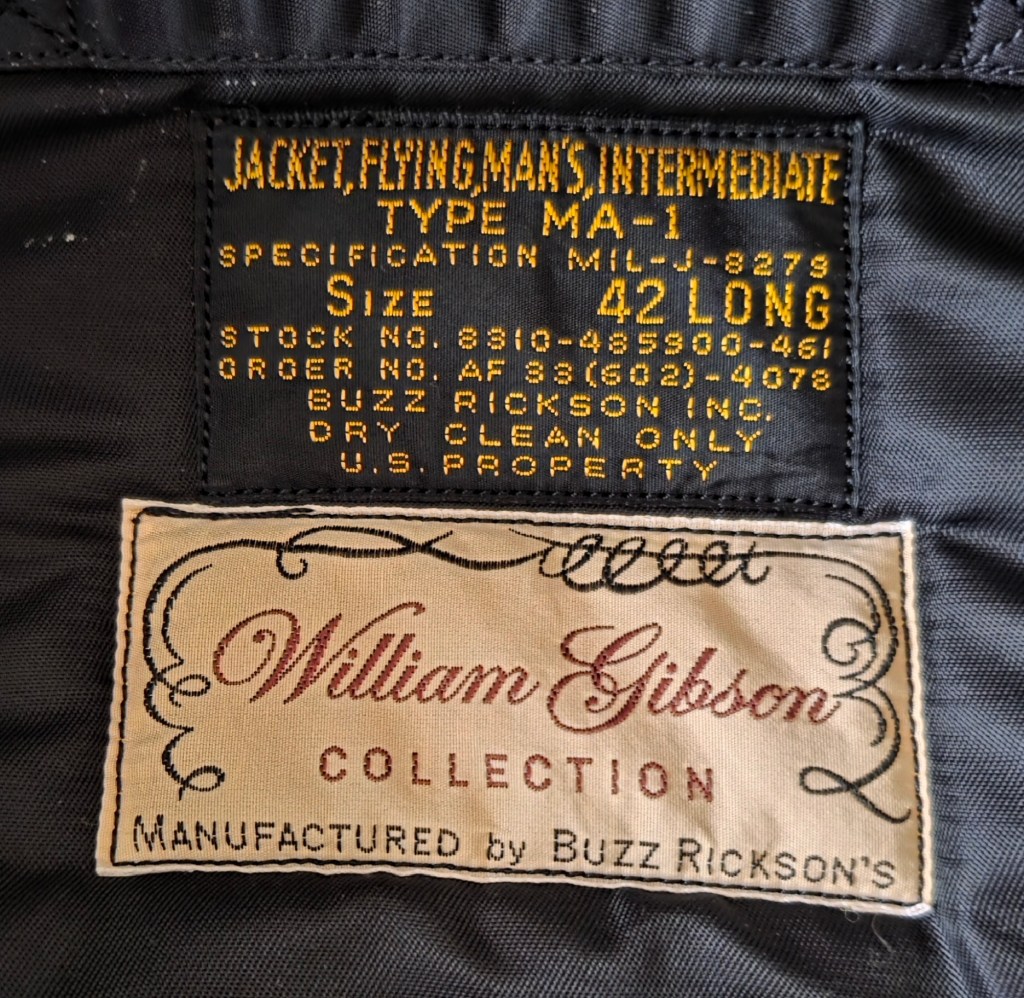
A brand new exact copy. Exact, and in this exact, better made than the original ever was. More solid. More sturdy. In a very strange, compelling way, more real and much more cool. Not unlike his protagonist, Gibson has become a coolhunter whose fictionalised representation of our over-branded, commercially predatory world connected to a market (letters from people, asking where they could buy one) to exploit and a company to exploit them (Buzz Rickson). The paradox, then, reraises its problematic head. Beyond fashion = cool = commodifiable = within fashion. Not that this stops any of us from coveting one. I coveted it and was only able to get my Gibson-rereading, nerdy little hands on it because it was second-hand. A new example goes for anywhere between $680 to $990 USD, a price supposed rationalised by Gibson because they are “carefully handcrafted, an authentic real thing in an economy of fakes, and that their cultural aura of cool is—in this case—justified”15. And why not? Not only is the jacket extremely well made and entirely functional, it is a reality-hopping migrant which has traversed the fictional to land in factual. For somebody who writes fantasy and sf I’m hard pressed to picture anything cooler.
To a tangible extent, the jacket is imbued with Buzz Rickson’s “obsessive” desire to reproduce American military garments to exacting standards, Gibson’s aesthetic/philosophical attachment to Japanese makers of heritage military/workwear, and Pattern Recognition‘s explorative critique of the market forces to which both of the previous points are direct responses.
Heavy stuff!
Almost as heavy as the jacket itself.
When you wear it, you feel it. Across your shoulders and around your arms. The romantic, purple-prose dabbling scholar in me also think that to wear it is to enter the textual worldview of the narrative that invented it. It is to access its chain of production from and through the novel, to its collaborative fabrication, and into the associated the Buzz Rickon advertising. And there is something potentially unsettling in this idea.
Last week, it was suggested that the production of the jacket was akin an “act of worship”, inferring something spiritual, if not religious about bringing the garment into existence. And this act is not simply sequestered to its production, it is disseminated amongst those who frequent spaces like r/rawdenim, r/Selvedge, r/HeritageWear, and r/BuyItForLife. In the opening section I used the word “grail”, omitting the usual prefix of “holy”. Perhaps, it shouldn’t have. There is a degree of veneration glommed onto the MA-1 which resonates with the logical outcome of Konstantinou’s analysis of brand management strategy. The argument runs: “the marketer should seize the loyalty of a small but fanatically devoted coterie of true believers. Religious cults, or ‘cultures of beliefs’, thus become models for what brand builders aspire to create”16. The model here is to set up the brand as a core aspect of the consumer’s identity, to combine their story with that of the object of veneration (the jacket, the iPhone, max cushion runner, the luxury watch, etc.).
In the case of the MA-1 this model is complicated by the fact that just as cost of and commentary around the jacket mythologises, the story that birthed it, the story it transmits, demythologises that same mode of production. To wear it, then, is to tightrope walk between competing perceptual schemas of reality: fiction and fact, conformity and rejection. To wear it is to be allowed, if not forced, to see these realities held in tension, friction, and flux; to be literally zipped into a “certain aesthetic relationship to one’s object world as a (possible) precursor for action”17.
Or … you know, it’s just a cool jacket that keeps you toasty and dry in winter.
At the end of the day, the choice is yours.
- Schuck, D 2015, “William Gibson Interview: His Buzz Rickson’s Line, Tech Wear, and the Limits of Authenticity”, https://www.heddels.com/2015/03/william-gibson-interview-buzz-rickson-line-tech-wear-limits-authenticity/ accessed 08.02.2026 ↩︎
- Konstantiou, L 2009, “The Brand as Cognitive Map in William Gibson’s Pattern Recognition“, boundary 2, 36:2, p.71 ↩︎
- ibid, p.90 ↩︎
- https://www.cleanup.org.au/fast-fashion/?gad_source=1&gad_campaignid=19217001105 accessed 08.02.2026 ↩︎
- Konstantiou, op.cit, p.93 ↩︎
- ibid, p.70 ↩︎
- Gibson, W 2003 (2011), Pattern Recognition, Penguin Books, London, p.16 ↩︎
- ibid, p.85 ↩︎
- Konstantiou, op. cit, p.68 ↩︎
- Gibson, op.cit, pp.10-11 ↩︎
- ibid, p.138 ↩︎
- Schuck, op.cit. ↩︎
- ibid. ↩︎
- ibid. ↩︎
- Konstantiou, op. cit, p.96 ↩︎
- ibid, p.91 ↩︎
- ibid, p.95 ↩︎
 Narrative Gauge Sweater
Leave a comment