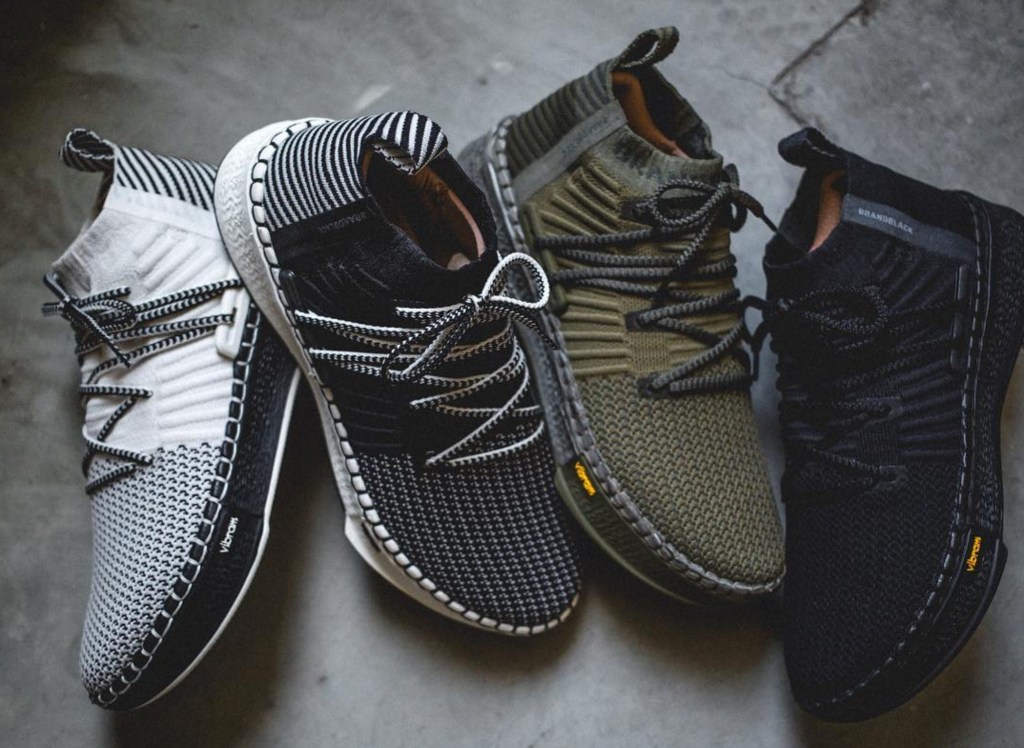
Given the almost overwhelming abundance of sneakers flooding the contemporary market from the likes of Nike, Adidas, Reebok, Asics, New Balance, Saucony, and Mizuno, the fact that my sneaker journey truly began with Brandblack Delta may be as implausible as it was destined.
Let me explain.
I’m a baby of the late 80s. Born and raised alongside the forests of Melbourne’s Dandenong Ranges, one of the first things I did when I was old enough to really do anything was play basketball for my local club, the Olinda Bushrangers. Aping the LA Lakers, our colours were purple and yellow and we played every Saturday morning, traction squeaking over the polished hardwood, a sound indelibly scratched into the grooves of my mind. I mention the colours of our cross-pacific cousins for specific reason. In Australia, in the 90s, in a household without cable/satellite TV, the NBA was distant, almost a mirage, but for one thing: a VHS of Learning to Fly, a documentary charting the championship run of the 1990-91 Chicago Bulls. Not ever 10 years old, I was unaware of terms like dynasty and legacy. What I was aware of and entranced by was the atavistic meeting of Erving “Magic” Johnson and his heir (air) apparent, Michael Jordan.
I watched that tape with something bordering on ritual. Lines were memorised. Music was hummed. The drama thrilled and playmaking inspired. What I didn’t make note of at the time were the shoes being worn by these titans of the game. As player, though, shoes were part-and-parcel of the game. They were part of my life and, even without my knowing, their story was part of mine.
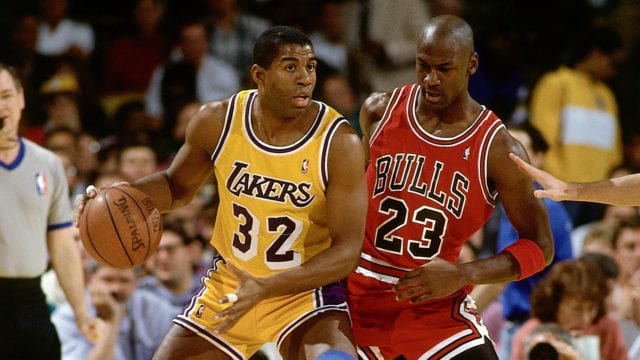
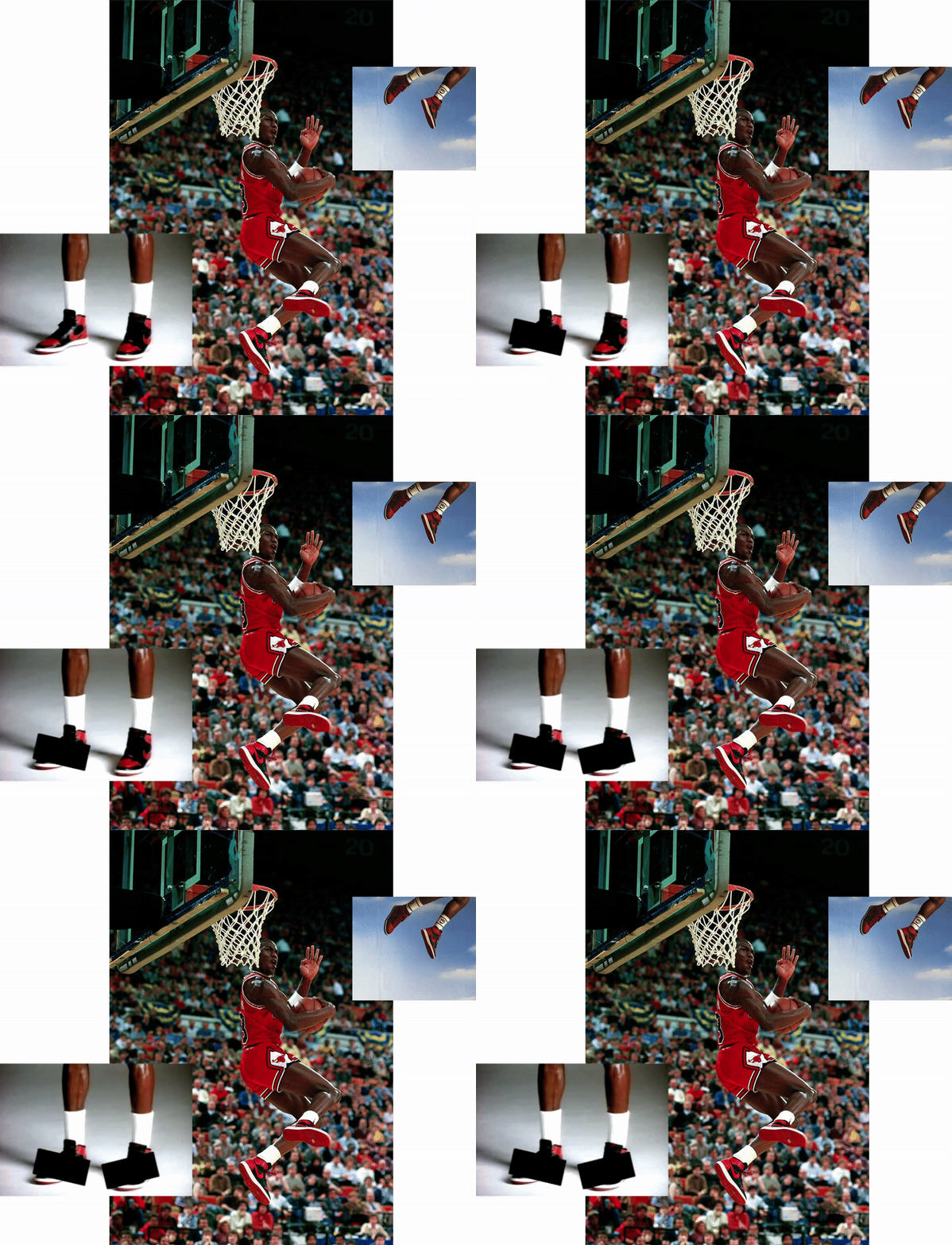
In the background to my weekly games, a knot of culture, marketing, and identity had been tied. Recounting the steep ascent of Jordan’s first signature sneaker, the Air Jordan 1, Ian Stonebrook, writes that “[r]etailing $65 a pair in adult sizes, the Air Jordan 1 and corresponding clothing accounted for $100 Million in US sales for Nike in 1985 alone—almost double Nike’s total brand sales a year before”1. Obviously, it was popular. And this popularity, then and to come, was a moment that changed the face not only of basketball as a game, but basketball as a mass-marketed product braided tightly to the 90’s zeitgeist.
I never saw Spike Lee’s “It’s gotta be the shoes” commercial (1988) when it aired, nor his Do the Right Thing (1989), but even without watching them then, they informed the landscape upon which I matured. The idea of “being like” somebody else is now, I’d argue, an intrinsic part of sneaker ownership. Prosaically, one can buy signature sneakers of perennial stars like LeBron James, James Harden, or Kevin Durant, making choices between them based on play styles, tooling aesthetics, and/or personality. There is something aspirational at work alongside matters of taste. In terms of Jordan, it wasn’t simply about playing like Mike, it was about what playing like Mike entailed. It was about playing “cool”. The longer shorts. The shaved head. The tongue out on the way to the basket. Defying gravity. Here was the new superstar ushering in a new NBA, taking the reins from the old guard of Larry Bird, Magic Johnson, and Isiah Thomas, known for wearing Converse and Puma respectively. And just as the topography of the NBA was changing, so too was its, and its fans, relationship to footwear.
In a qualitative study focussing on “sneakerheads”, published in Fashion and Textiles, Matthews et. al. argue that “[t]here is a need to understand Sneakerheads from motivational, brand preference, and identity perspectives, as this will greatly inform how sneaker brands appeal to this subgroup”2. For them, there are two motivational forces defining sneakerheads.
- “Most Sneakerheads credit the advent of the Sneakerhead subculture to the late 1970’s/ early 1980’s and the introduction of the hip-hop era. During this time, footwear became synonymous with streetwear, and notable sneakers, such as the suede Puma Clydes, Adidas Shell Toes, Converse Chuck Taylors, and Pony David Thompsons were introduced.”3
- “Yet, a large majority of Sneakerheads attribute their introduction to the sneaker community to the 1985 release of the Nike Air Jordan 1s. Arguably one of the biggest sneaker introductions, the shoe gained its notoriety because of its connection to the athlete Michael Jordan, but also because the shoe was initially banned by the NBA after Michael Jordan wore them on the court.”4
In both case, the potency of the sneakers relies on its cultural imprint, linkages, and transmission. The first exists within a broader swathe of cultural transformation that witness the suturing of an American musical revolution to the widening appeal of the modern NBA. The second places the onus on a specific moment with a particular controversy: the “banned” Jordan 1. And while contemporary interpretations suggests that the infamous Jordan 1 was only worn once during the 1985 Slam Dunk context, the rebellious narrative surrounding them took hold in the cultural imagination. Regardless of the when, it is this narrative factor, according to Matthews et. al., which still plays the key role in sneaker desirability amongst their consumers.
As part of the qualitative study, Matthews et. al. interviewed several individuals of what they called the sneakerhead community, a loose social group they categorise as people who “collect, trade, and/or admire sneakers. In addition, most are knowledgeable about the history of sneakers, and are passionate about the nostalgic factors the sneakers possess”5.
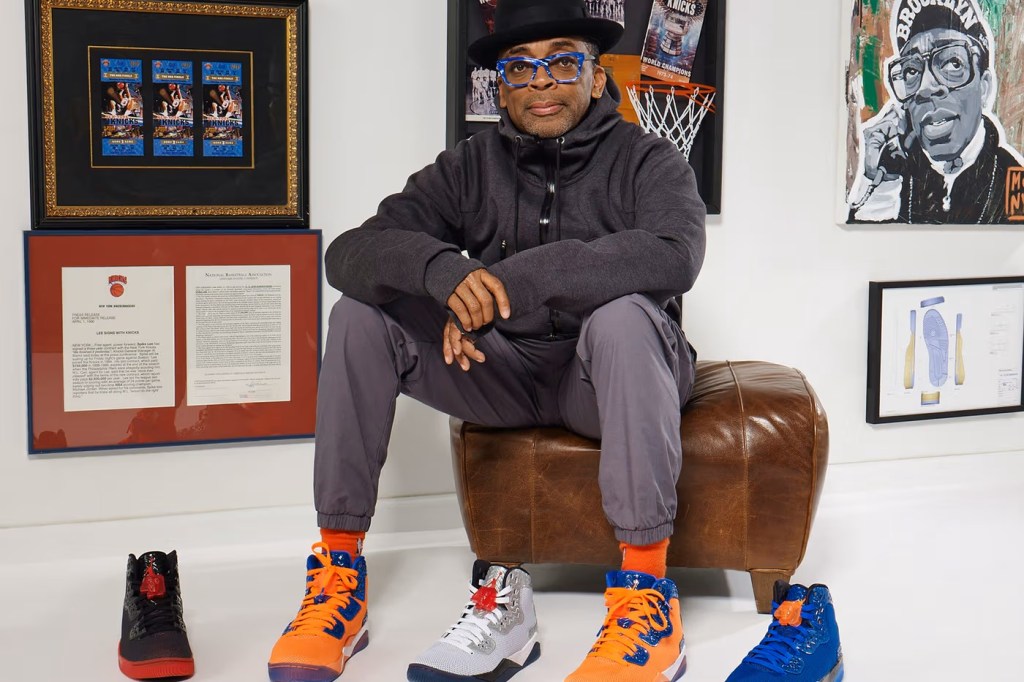
Each sneakerhead, of course, possessed a story, a sneaker story that acted like something of a foundational myth. Jason, one of the study’s subjects, link his obsession with sneakers to the introduction of the Air Jordan line, claiming that, “I wanted them so bad! They looked so different. That was the first time that I really noticed them… like wow, I like these sneakers“6. Another, Elijah, mentioned the degree to which sneakers became symbols within an emerging pop cultural reference system being drafted by films like “Do the Right Thing” where a character has “a pair of Jordans, and somebody scuffs them with a bike. So, he gets in an altercation with him. You know, it really kinda supported and reinforced the love people had for their shoes and for style during that 90’s era“7
Want. Difference. Style. Love. These descriptions, indicative of all the study’s respondents, renders the object into a cultural artefact whose narrative connectives to players, places, movements, ideas, and histories transforms leather, synthetics, foams, and rubbers into an object of near veneration where every facet of its ownership — the researching, hunting down, purchasing, wearing, and discussing of — is ritually inscribed with tales.
The tale of how it was made.
The tale of who it was made for.
The tale of where it belongs in market.
The tale of what it recalls from history.
Aware of these tales, we can return to my own and its attachment to the Brandblack Delta. It is 2017 and I’m walking down the steps into the shoe basement of old McKillop Street location of Up There Store. The ceiling is low, the walls unadorned save for simple shelves of sneakers. Perusing the usual stock of Air Jordan 3s, Adidas Handball Spezials, ASICS Gel-Lyte 3s, and assorted New Balance models, I find what I’m looking for. The Delta is a blackout, the only hit of colour the orange Vibram logo on the forefoot lateral midsole. Sock-like and crisscrossed with laces, it is a basketball shoe, but unlike any basketball shoe I’ve come across.
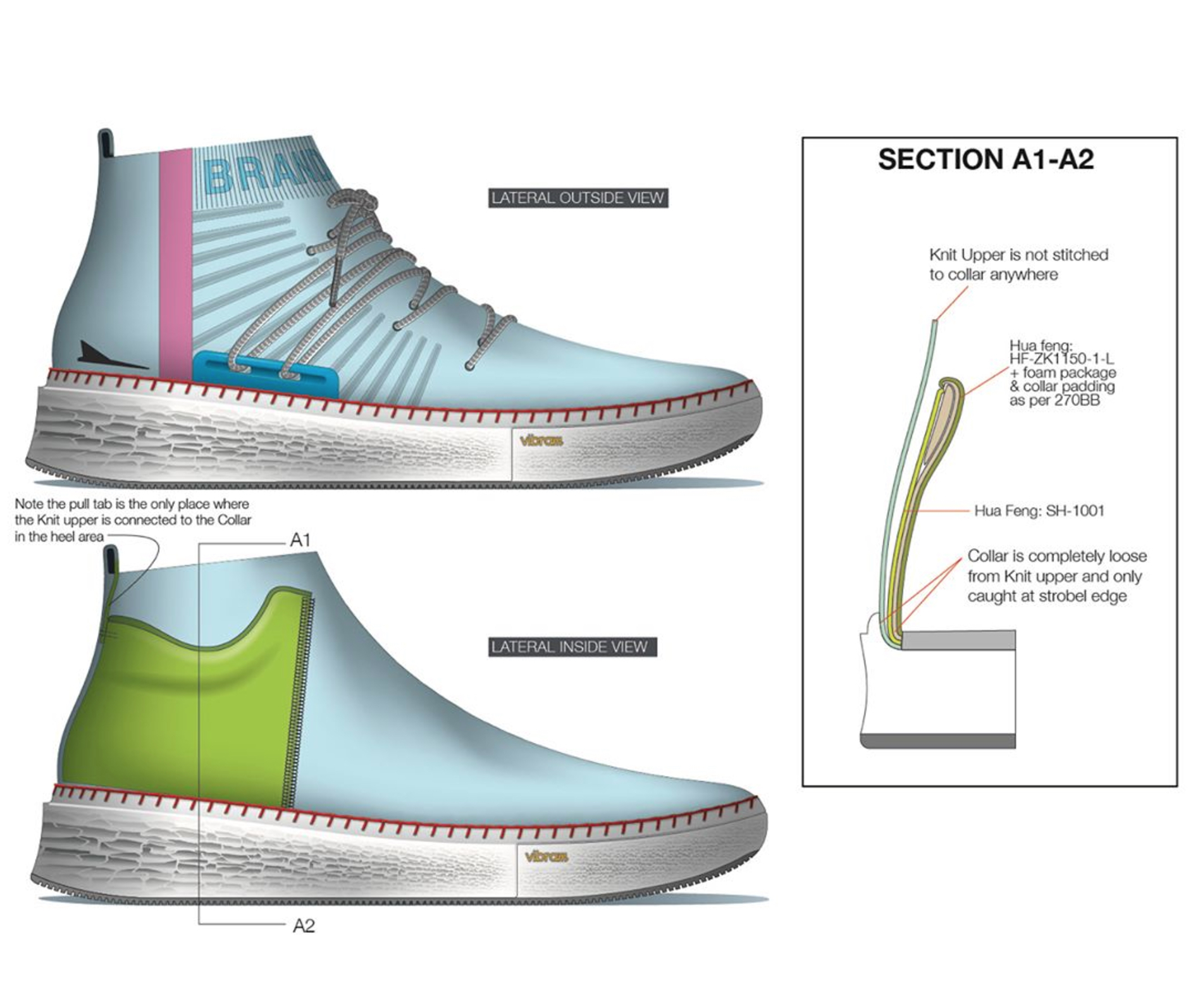
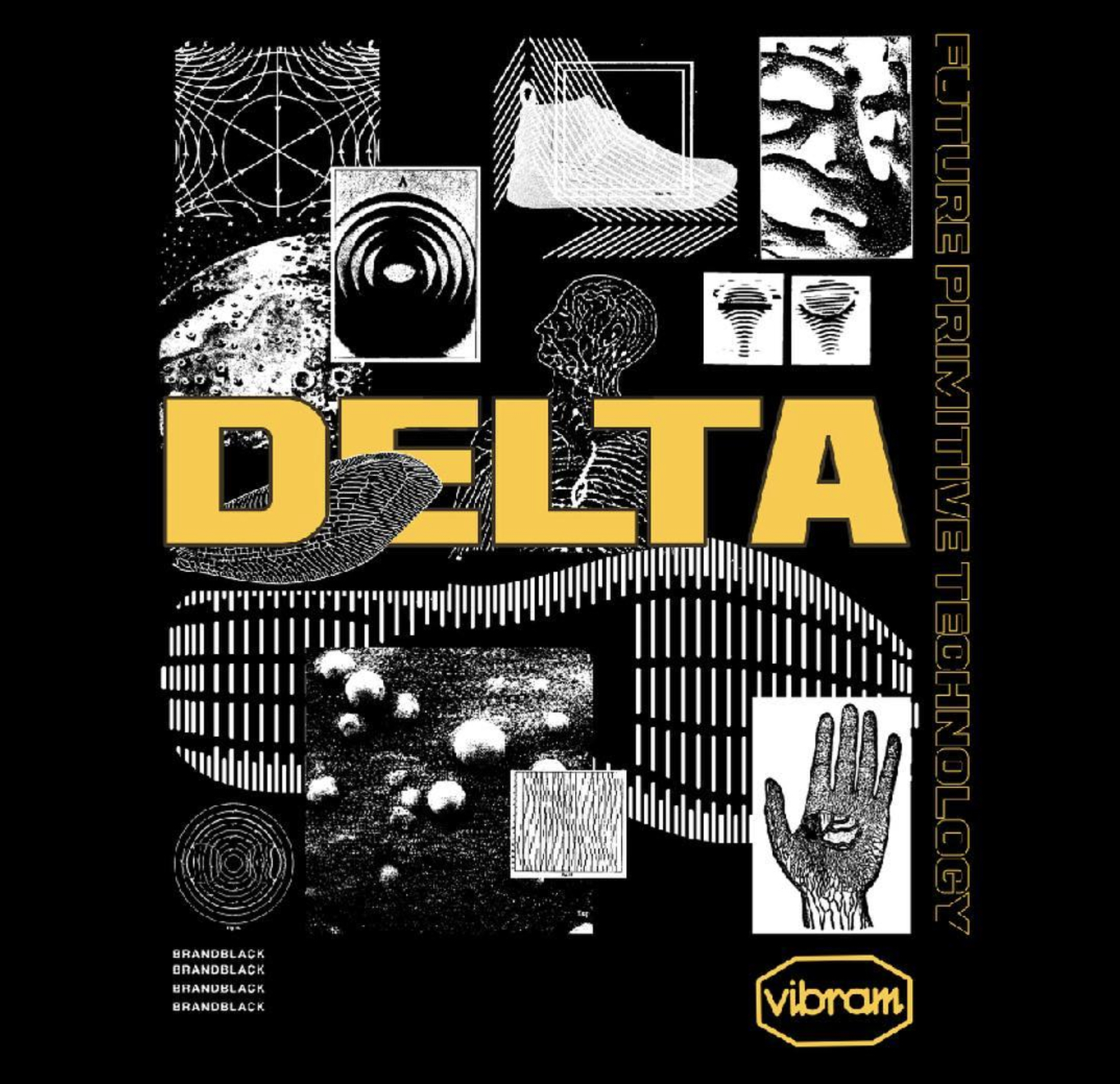

For a start, Vibram and basketball are two words that, until this moment and this sneaker, have not come into contact. Then there is the fact that I grew up in are era of leather, suede, nubuck, mesh, and hardy synthetics, and only associate full knit uppers with things like the Ultraboost. This is, of course, why I’ve come. Brandblack, at this point a relative newcomer and minnow on the scene, markets the Delta as “innovative” and “radical”, using “the first-ever Brandblack sole designed with Vibram, a storied Italian footwear company, and a zonal engineered sock-like flat-knit upper that should offer support in targeted areas. The shoe also uses an internal support collar, a thermo-plastic heel counter, and support mat lacing system”8. A whole slather of marketing lingo, but compelling nonetheless for everything that the shoe isn’t. It isn’t Nike, Jordan, Adidas, or And1 (yes, I’m old enough that this was what everyone was wearing on court for several years!). It is different. It is trying to be different.
I first became aware of the brand and the model while watching Nightwing2303, aka Chris, of weartesters.com. Back then, Nightwing was my go-to for sneaker releases due to his impulse towards positivity, fellow lover of 90s pop culture, and basketball background.
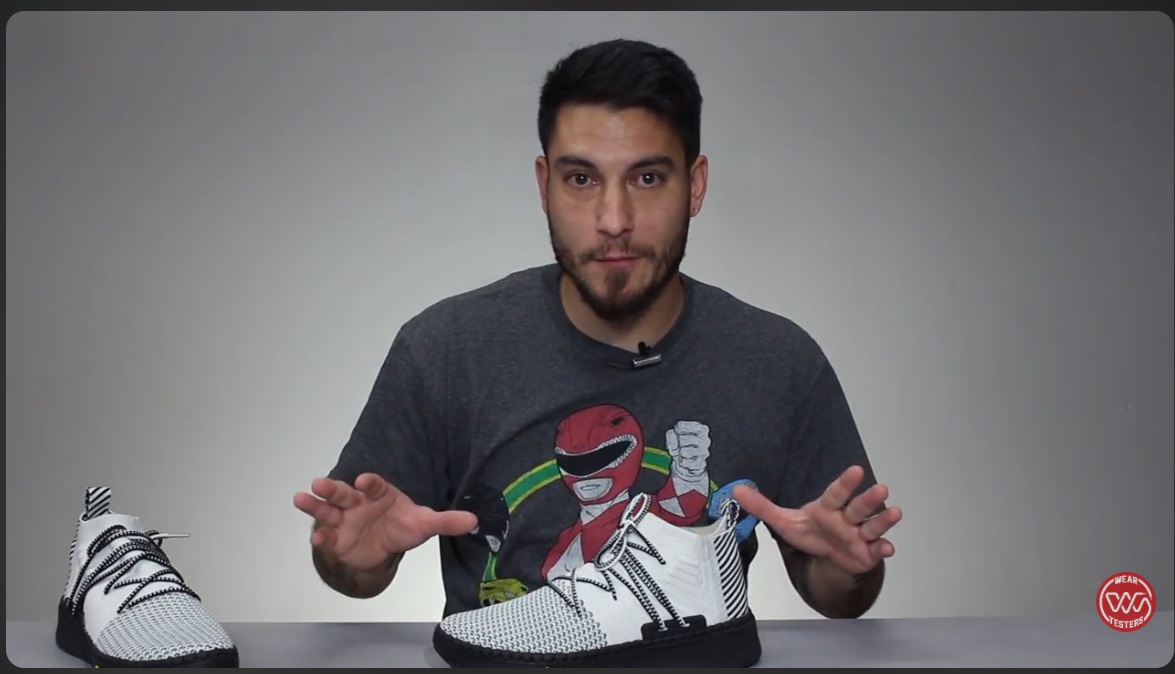
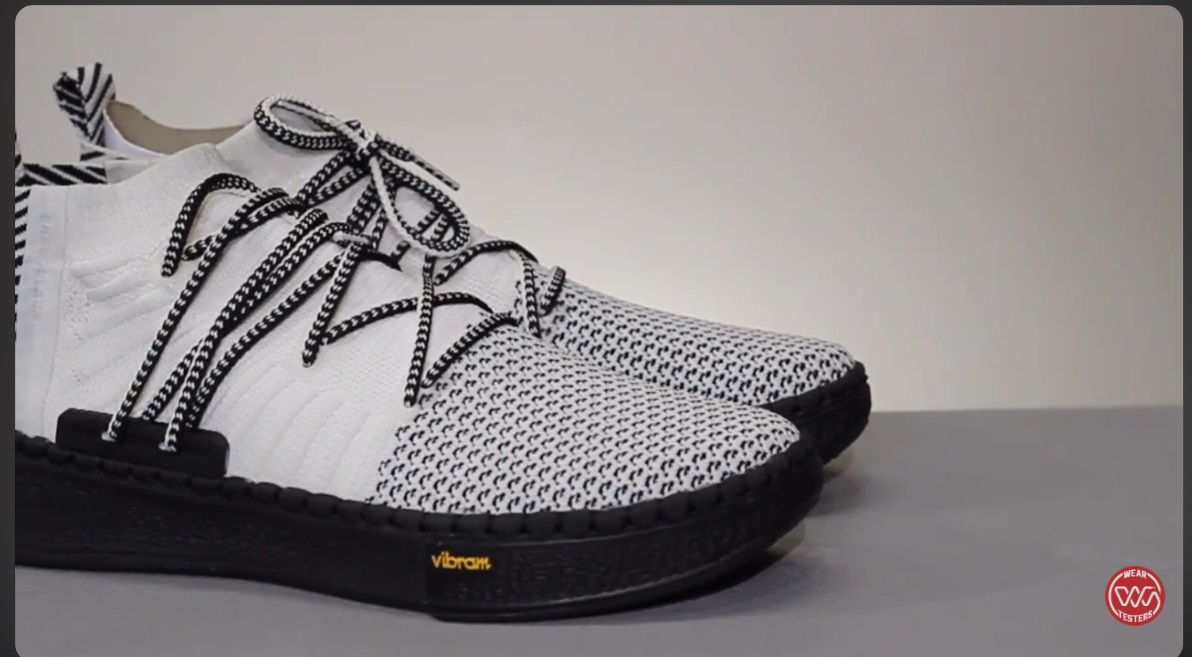
With the Delta in hand, it was the first time I’d gone from research to try on, and it felt like I’d stepped across into a different, more interconnected world. The fabric was stretchy and stiff. Somehow I managed to jam past the blockade of the padded collar and felt the upper wrap my feet. One tentative step. A second. A quick squish of the heel. The midsole was responsive, if not stiffer than I expected, and the sock liner delivered sold step-in comfort. The ride was smooth and the all black look lent the sneakers a technical vibe I was happy to add to my outfits. I left Up There with my first pair of “proper” sneakers, and they were not the last. Not by a long stretch. Not at all. Nope.
Time passed.
I bought more sneakers.
I purchased plastic shoe boxes to protect and display them.
I bought a few more.
And with each new acquisition my interest was whetted further, prompting me to explore the Jordan 2, Nike Killshot, ASICS GT-II, Mizuno Neo Vista, and New Balance 2002R, among others.
Many others … some would say too many. And maybe they’re right. However, there is something compelling about sneakers. It isn’t just that they carry these stories. It isn’t just that they speak a distinct socio-cultural language shot through with nostalgic call-backs, contemporary trends, ties to sport, threads into community. They are also engineering marvels. Nike’s Zoom units bristle with tensile fibres. Running shoes use carbon plates for torsion control and energy-return propulsion. Some foams are infused with nitrogen while others are thermoplastics treated with high heat and pressure. On innovates with cut-out midsoles; Hoka brought 40+mm heel stacks into the mainstream. In many ways, these sportswear companies are biotech companies involved in a footwear arms race, determined to be the lightest, fastest, hardiest, most waterproof, most comfortable shoes for high-performance athletes and everyday supermarket strollers alike.
For a time, I was interested in owning a model from each of the major players. I had my own questions. What was the difference between Boost and React? Was a synthetic textile better than natural? Did cushioning in the heel cup really do anything? Did Gore-Tex work when applied to a retro sneaker? Would this or that colour way work with jeans, running shorts, tracksuit pant, and chinos alike? Were ankle sock the go? Tube socks? Maybe no shows? So many questions and a sneaker to answer each of them. Always a new release, the latest iteration. I was deep in the weeds of it, watching Brendan Dunne, Matt Welty, and Trinidad James on Full Size Run while scrolling write-ups on Hypebeast or checking launches on End. Tinker Hatfield became a figure of study. I bored friends and family nattering on about the evolution of tennis shoes worn by John McEnroe and Andre Agassi. I lined up for the Air Jordan 6 “Infrared” (a post on this to follow). Strobel board, medial side, toe box, gum sole, herringbone traction, 3M, and volt green entered common parlance. No longer a kid beholden to my parents’ acquiescence, I sacrificed disposable income on the alters of the swoosh, three stripes, jumpman, runbird, NB, and vector. Hooked is the word. Obsessed to the point of penury its dyslogistic, and in an advanced state of heightened fascination a kinder descriptor of symptoms.
*sigh*
Indeed, my fascination for sneakers and the narratives surrounding them have even become an integral part of my fiction, the details of their construction, innovation, and aesthetics tying past to present to potential futurity. Here is a world-building example from a draft of “The Beekeeper of Leftover Melbourne”:
The Bunnings Junction roiled with activity, the cavernous warehouse thrumming with competing voices. Dozens of boats were roped together alongside rickety pontoons and makeshift piers, each one packed with different goods and professions. Hammocked stalls hung from the roof girders trailing rope ladders and aluminium buckets. Deals were shouted, exchanges bargains over calloused handshakes. Possums in possum boxes looked down as sleepy witnesses. Kalahar had crept in late, easing her way through the press and found Lommy Air Max, the unflappable sneakerhead displaying his latest reclaimed retros from a cabin cruiser painted black with a white tick.
A drumline of rain on the warehouse’s steel roof. Commerce boiled around them, sampans and rafts dodging old steamers and teams of coxless quadruple sculls. A nexus for nomads, frontier farmers, tradies, land carers, and eccentrics, Bunnings Junction was the place to find everything you needed and then some. Eggs were sold beside seedlings and scrap metal, scrounged bricks and pavers, repurposed timber, tools, bread, dried seaweed, hemp products, mushrooms medicinal, fish, yabbies, deep-fried insects, clothes, and all sorts of services for hire. At its centre, the ritual sausages were being sizzled with onions and homemade tomato sauce. Yes, a place for finding, but also getting lost. On the mezzanine level and up the paralysed escalator families had pitched tents, parents sitting around butane camp stoves while their kids played chasey.
Accepting a jar of honey from Kalahar, the sneakerhead hopped back to his boat and busied himself with a few guys hunting for kicks with Gore-Tex or anything in a size fourteen. Lommy talked shop in an antediluvian dialect chock-full of primeknit, single-bootie construction, torsion plates, zoom bags, traction patterns, fits true-to-size, break-in period, OG colour ways, and boost, always boost.
By way of context, the story is what the industry labels “post-apocalyptic”, set in a climate change flooded Melbourne, its narrative gaze split between the world that was and a world that could be. To achieve this, sneakers, as seen above, were used as something of a cultural and material shorthand, the recitation of their 20th/21st century nomenclature invoking an entire reality nostalgically tattooed with sport, music, locale, and language.
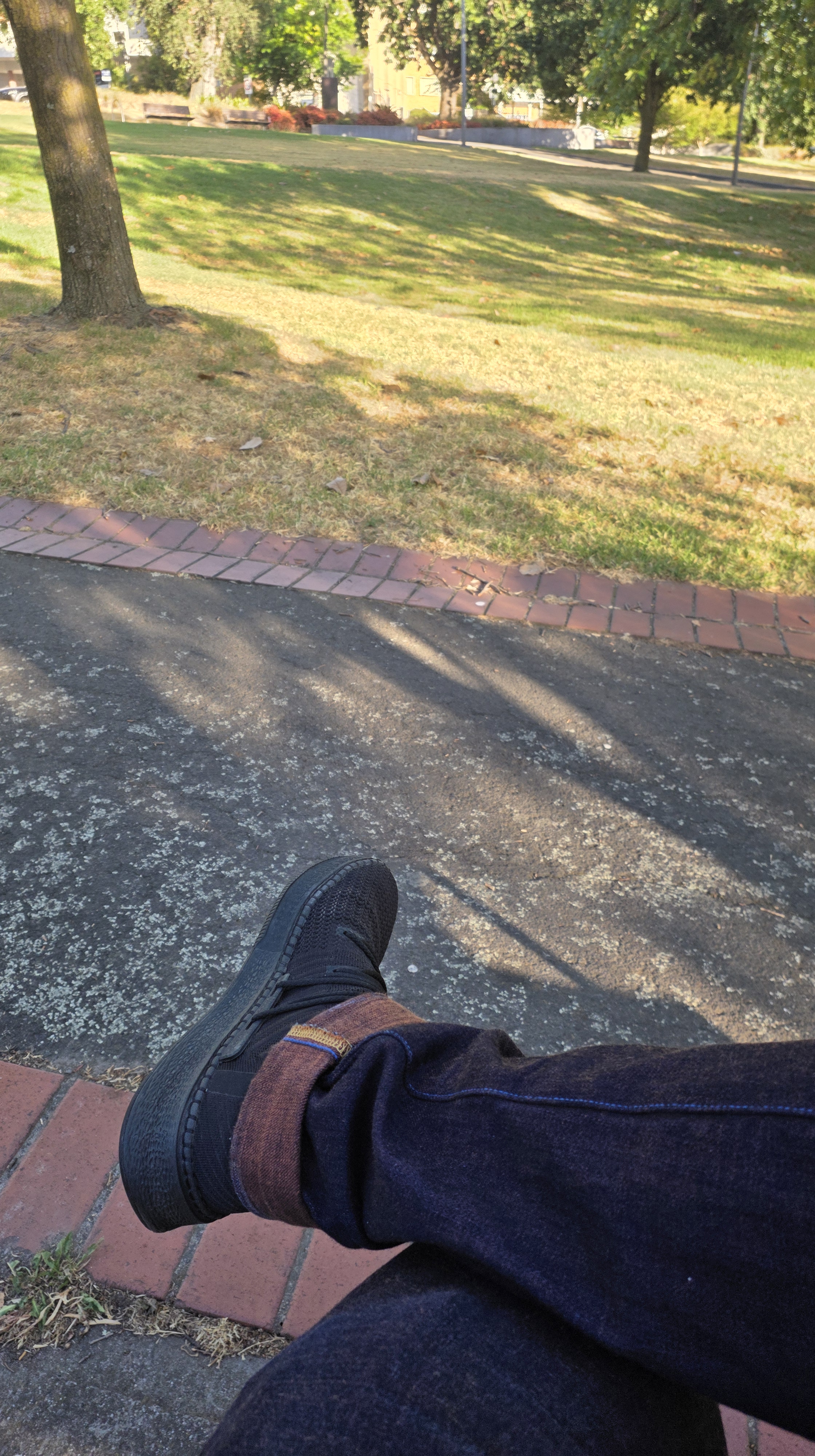
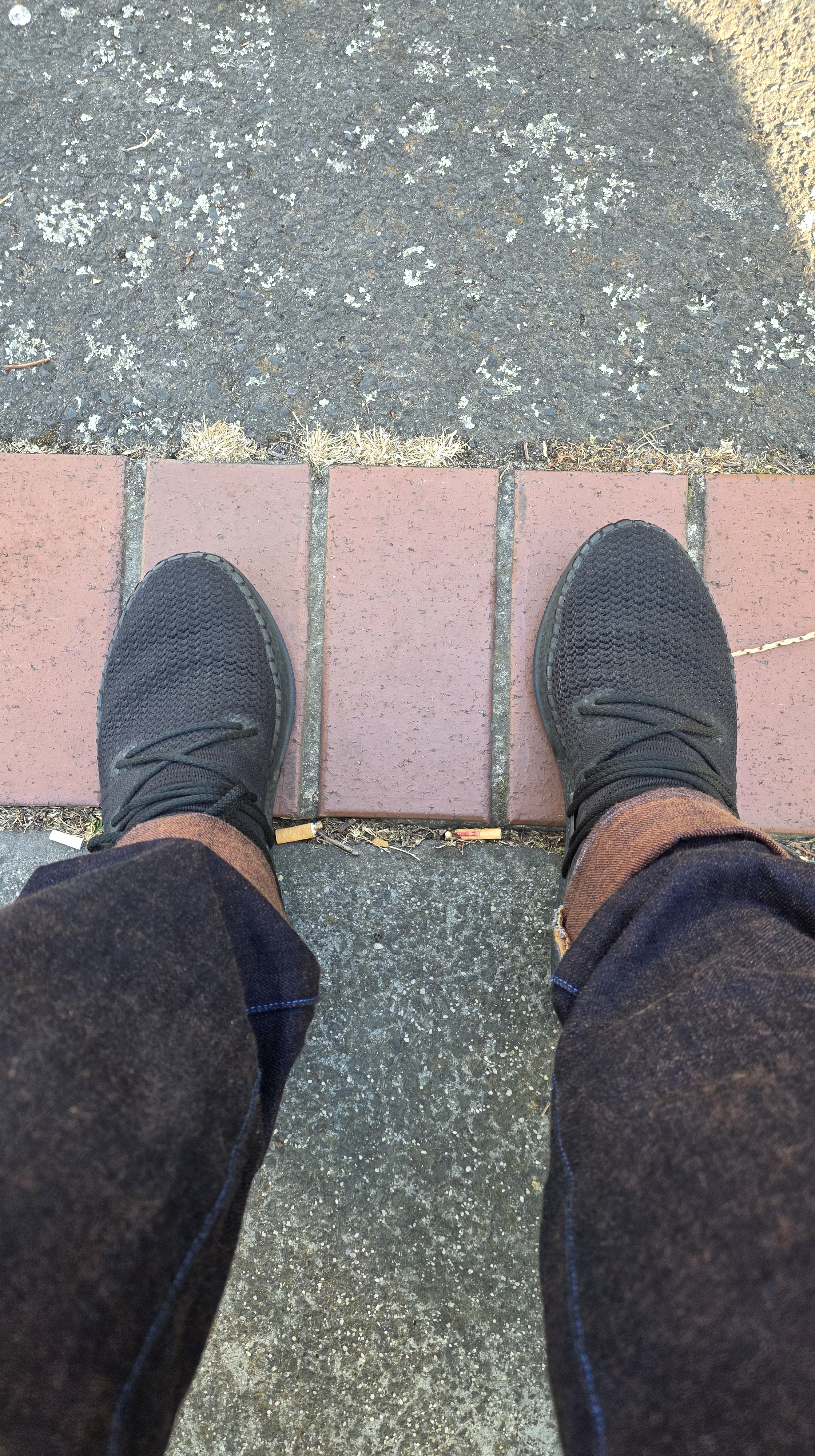
Which brings us back to the Brandblack Delta. After nine years it is still a sneaker I own and wear. Even though knitted, one-piece bootie construction became de rigueur for a stretch, I never held a shoe quite like it. The knit is denser, more rigid, more technical. The collar is higher, more textured, and the stitching binding upper to midsole recalls something more of traditional boot making than normally seen on performance sneakers. In many ways, these shoes are a culmination of things and ideas onto which my fascination fixed. They look back into a basketball history even as they attempt to step into an innovative future. They are mix of textiles and materials and construction techniques. And when I wear them it’s not like all this immediately or comes to mind–it’s just there, in the background, felt subtly through the footfall, glimpsed during a pause in the day, under dappled light, against pavement, hitting the bricks.
- Stonebrook, I 2023, “The Rise, Fall & Revival of the Air Jordan 1 Banned”, Goat, https://www.goat.com/en-au/editorial/history-air-jordan-1-banned-michael-jordan, accessed 16.02.2026 ↩︎
- Matthews, D, Cryer-Coupet, Q, and Degirmencioglu, N 2021, “I wear, therefore I am: investigating sneakerhead culture, social identity, and brand prefence among men”, Fashion and Textiles, 8:1, p.1 ↩︎
- ibid. ↩︎
- ibid, p.2 ↩︎
- ibid, p.1 ↩︎
- ibid, p.6 ↩︎
- ibid. ↩︎
- Goldowitz, N 2017, “The Brandblack Delta Has Finally Arrived”, Weartesters, https://weartesters.com/brandblack-delta-finally-arrived/, accessed 17.02.2026 ↩︎
 Narrative Gauge Sweater
Leave a comment