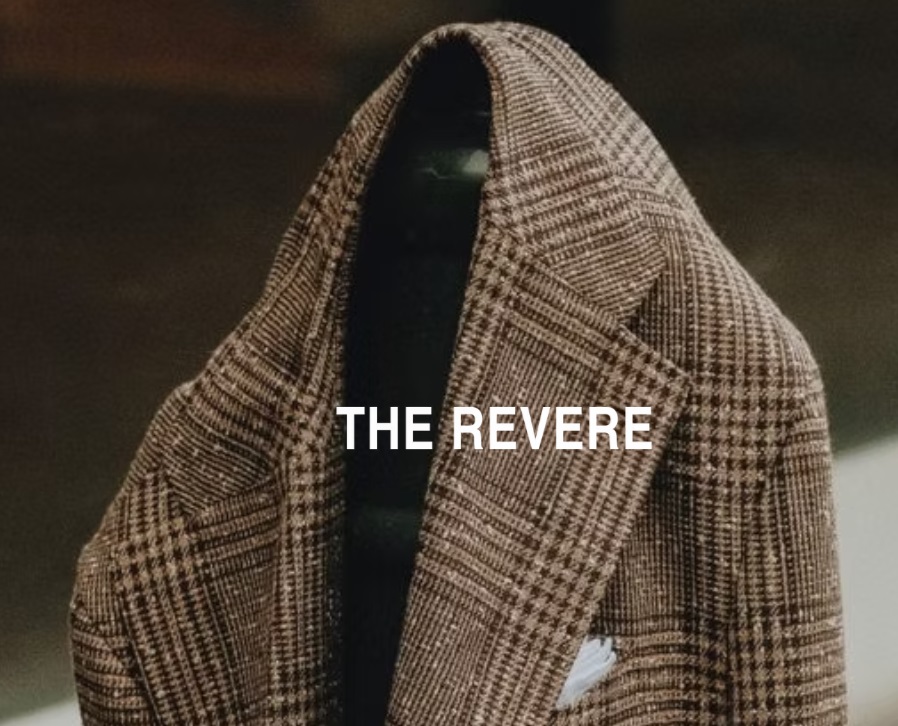
You decided to avoid Swanston Street in favour of Flinder’s Lane in a bid to miss the frantic crush. Off the train, a quick zig-zag slips into Degraves and the usual crowd packing the tables between Cafe Andiamo and Xpressomondo, their competing conversations burbling under sounds of passing cars and morning’s steady supply of pedestrians. Crisp bacon in the air. Dark roast and concrete warming gently in the sun. You side-step and shoots for gaps, head up, eyes sliding off faces onto the doric columns above the Eazymart. It’s still early for your appointment so you cross Flinders, ducking into Jungle Juice for a bagel and cafe bon bon, the sweetened condensed milk slicing sweet through the strong espresso. Jungle Juice, one of Melbourne’s many cultural institutions, you’ve heard, is a favourite of Stay Kids’ Australian leader, Christopher Chahn Banhg, the K–pop idol demonstrating remarkably fine taste. Bageled and caffeinated, you pay the bill, step back into foo traffic, and wander towards the Nicholas Building, the old tower holding high your destination: The Revere.
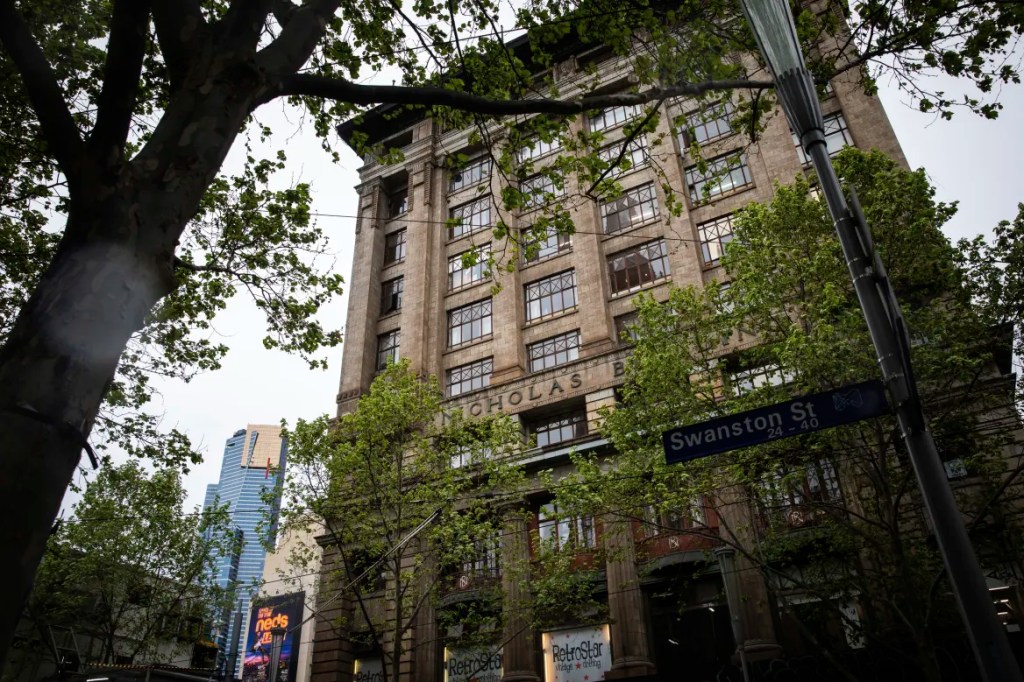
An aged, stone edifice grided by windows, the Nicholas Building appears vigilant. Opened in 1926, it has seen a century of the city’s growth and change from its enviable corner, becoming, in this time, a bastion/refuge/beacon/hub for Melbourne’s art, textile, and creative citizens. People come and go about its threshold. In the ground floor arcade, Cathedral Coffee is, in the local parlance, chockers, patrons spilling onto the tiled thoroughfare. Outside, the thin trees sway as a tram dings along. Beside the elevator’s you check and recheck a list of the tenants, the names, rooms and, floors clear beneath your reflection blinking in their protective glass.
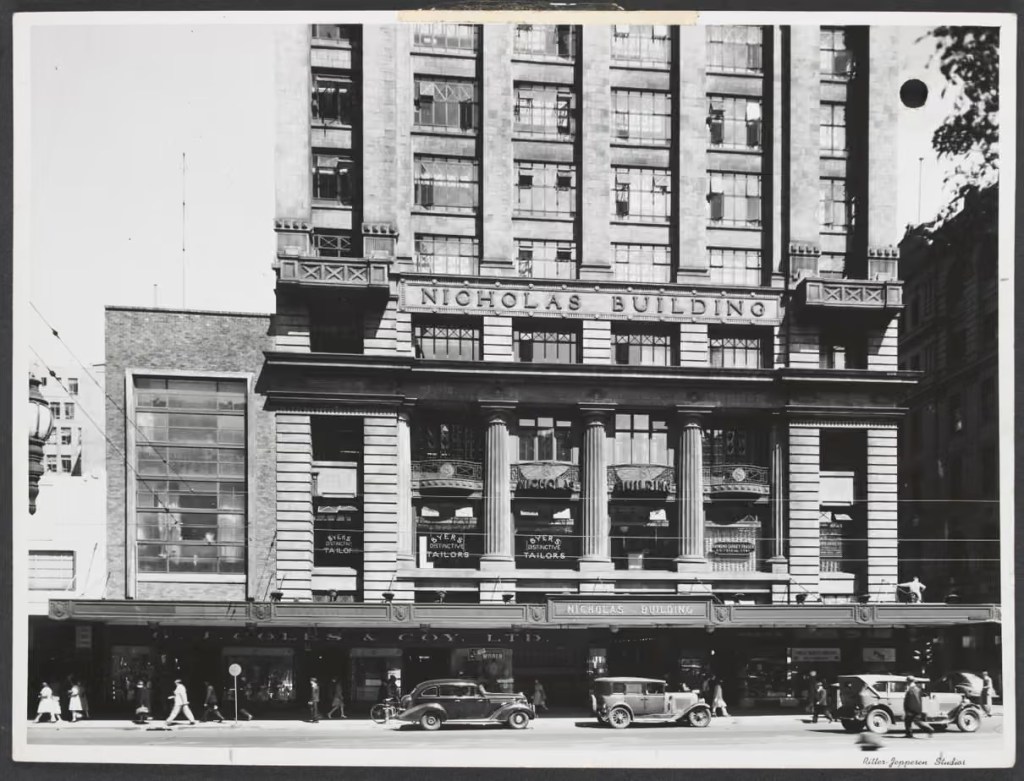
Writing for Meanjin, Ben Eltham, then a resident, writes that “Nicholas Building design is a prominent example of Melbourne’s inter-war style, with a Doric colonnade sitting above giant Ionic pilasters, and clad in a terracotta tiling”1. Locating the building in its time and place is important. Not simply a temporal cenotaph for a Melbourne lost and inaccessible, the building is better understood as a time capsule made accessible through both its architecture and the stories of the people co-habiting its spaces.
Eltham, of course, is not the only person to have located the potency of the building with its citizens. Brigid Delaney, writing for the Guardian, conceptualises the Nicholas as a mosaic of live rather than a layering of floors. Here we encounter the artists, designers, curators, booksellers, tattooists, tailors, shoemakers, and hairdressers who have set up shop. Not the we should understand this place in reductively commercial terms. A perfect example is Beverley Kannegiesser and the Austral Salon of Music, a second-floor locale from the late 1930s to 1957. Delaney explains:
“It was set up in 1890 by a group of women journalists so that they could talk about things to do with the arts, literature, science. There were clubs like it cropping up all over the world at the time. They had meetings twice a month and a lecture once a month on a set topic. They had music and dramatic items, but they always had a strong philanthropic arm. They did fundraising for the war, they made donations to the new arts centre.”2
What we witness here is a confluence of people, place, product, and politics made communal by the very nature of the maze-like structure of building’s design. Indeed, Christie Petsinis, a resident architect, made this explicit when she suggested that “It’s like a vertical village, with its 2m wide corridors like the streets” and that behind “every single door is something completely different and wonderfully diverse. People are proud and happy to be there – and everyone has a story about the building”3. And a story within the building. So, not only does the building link past and present, it is a spiralling hallway of doors that open into different artisanal realities. Such an idea isn’t exactly new in the language of rooms, doors, and portals, but the Nicholas Building concretises the concept on the rolling words of its website banner where is proclaims that it is “for politics, digital people, freaks, architects, grandparents, singers, dancers, artists, the citizens, teenagers, the common good, the commons, the people, culture, parties, punks, us, the fashionable, the unfashionable, galleries, the city, everyone”4.
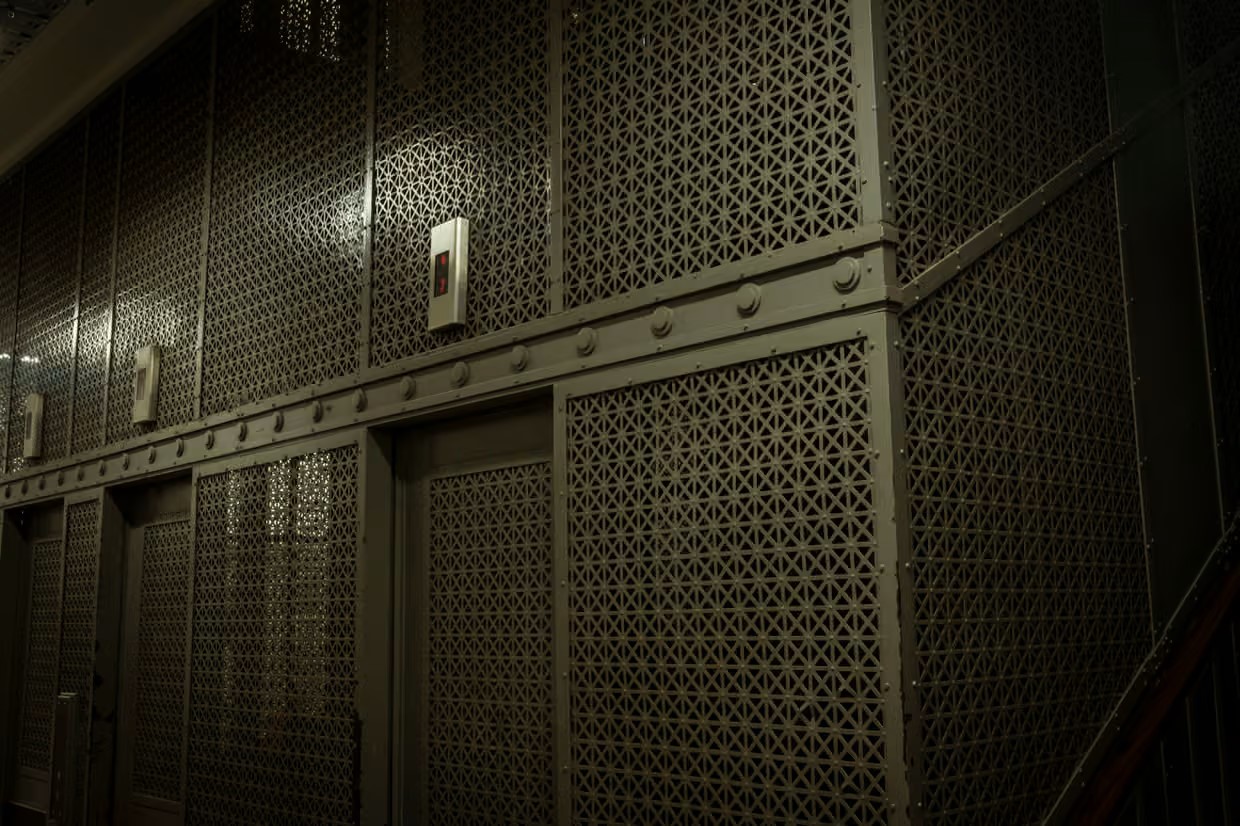
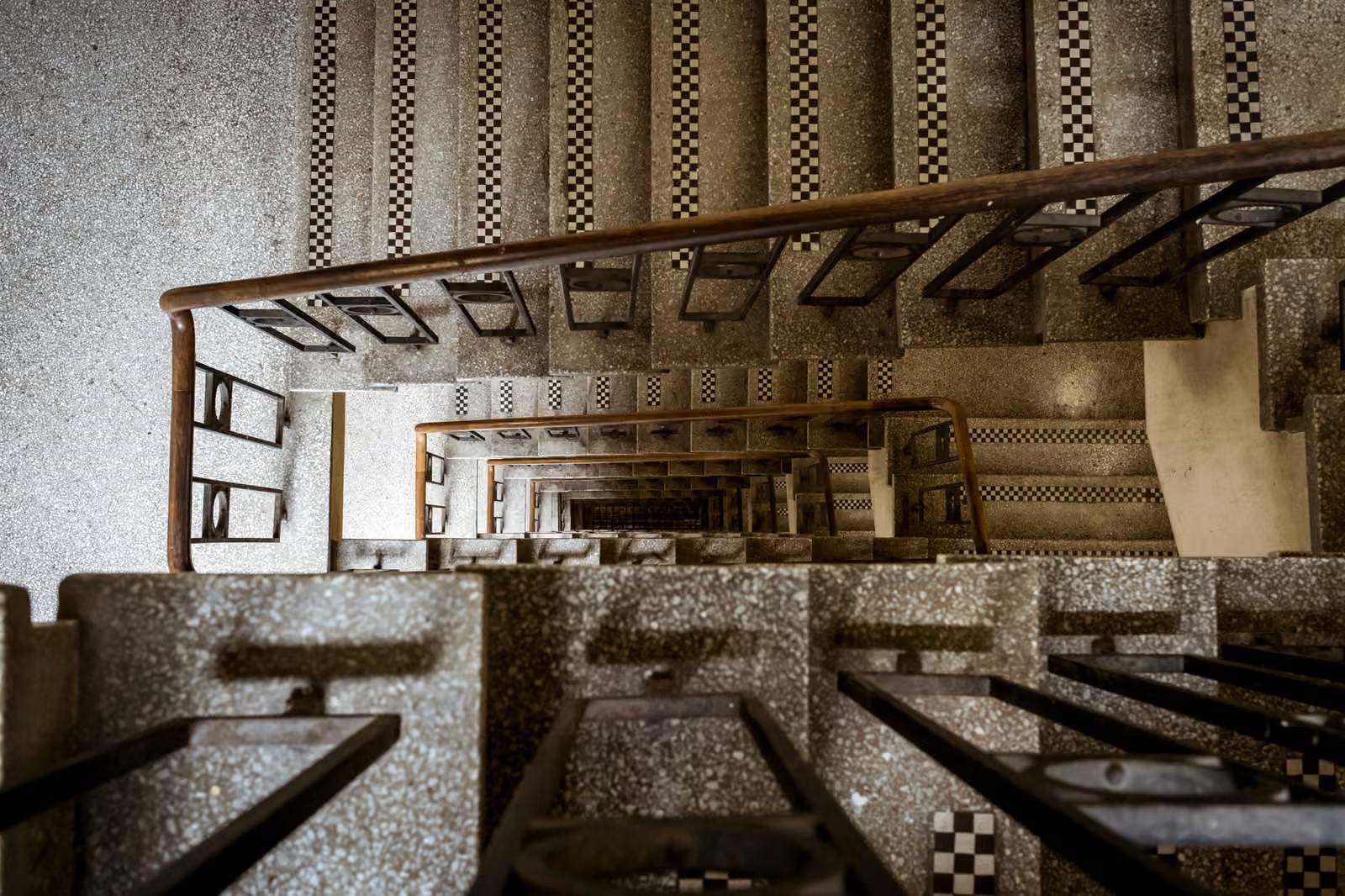
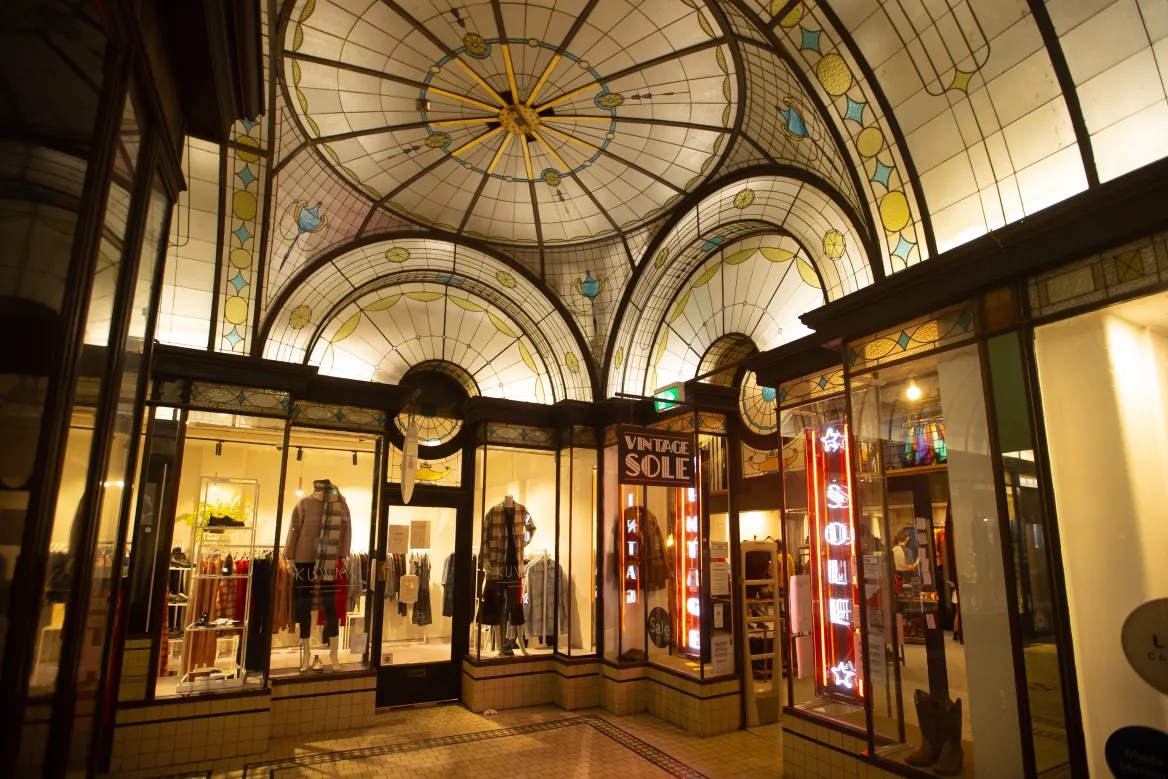
And there you are, in the confines of the elevator as its ascent groans and shakes and wheezes and clanks. Level 5. The doors rattle open. Dull light plays over yellowing tiles and smooth, polished floors from phosphorescent tubes. Repeating “Room 16, room 16”, you’re not sure if left or right is the correct option, the slow climb up discombobulating a sense of space-time. You’re not even 100% sure that you’re Melbourne anymore, the hallway disappearing around bends which could lead to nowhere, anywhere, or everywhere. You take a step. You take another. The room numbers are the only guide, frosted glass in doors revealing little of what exists on their other sides. Sounds reverberate once before falling flat. How many steps have you taken now? How many rooms have come, gone, and rearranged around you? Sweat trickles. Breathing heavy. Suddenly, the building feels as though it is alive, is watching you, is waiting for you to pause, to give up, to turn around and swallow you in the gullet of its stairwell …
Room 16. The Revere. Relieved, you knock. The door opens.
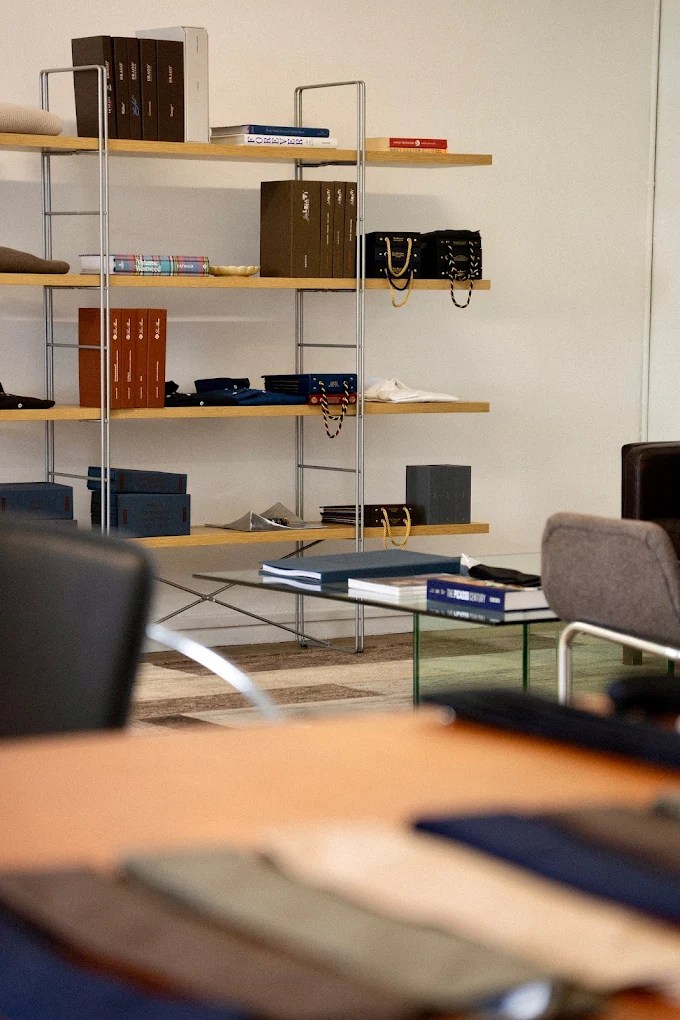
Steve Barkla, founder/owner and all-around garment wizard of The Revere, greets you are the door with a smile and handshake, welcoming into his space. High ceilings and clear windows embrace antique furniture, mobile racks of jackets and trousers, a broad table, and myriad paraphernalia of his craft. Already, you are in conversation–you have known Steve for years, since his time at Oscar Hunt. Japanese selvedge denim, Red Wing Iron Rangers, a love of dogs–these are things we share, their dialogue braided over the previous production of a grey-brown sports coat in a wool/silk/cashmere, wine-coloured corduroy jacket, and navy houndstooth shirt jacket. You feel at home. At ease. In the right place. Here is a little of the social magic of the Nicholas Building, taking the business of the day and transposing it into something closer to a chat between friends over what they love. And this love for the art of tailoring is obvious. The space is steeped in it, every aspect of its presentation echoing Steve’s abiding philosophy: the “pursuit is to create garments that are loved, respected and you can enjoy for years to come”7.
Beyond the first room, The Revere opens into large fitting room replete with plush couches and a shelf heavy with fabric swatch books. Sitting down, you lay the olive green linen jacket you’ve brought on a low coffee table, outlining your need for a shirt and trousers for an upcoming wedding. You want sharp, smart, but casual, wondering about the applicability of complimentary earth tones. Nodding, Steve pulls several swatch books from a nearby shelf.
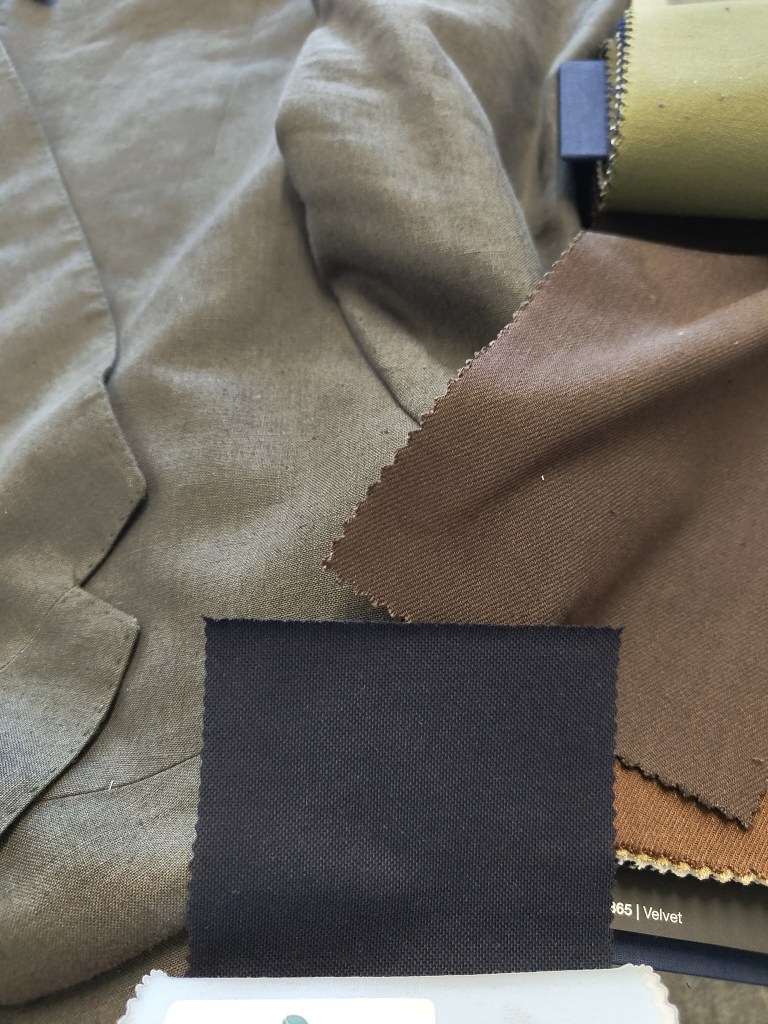
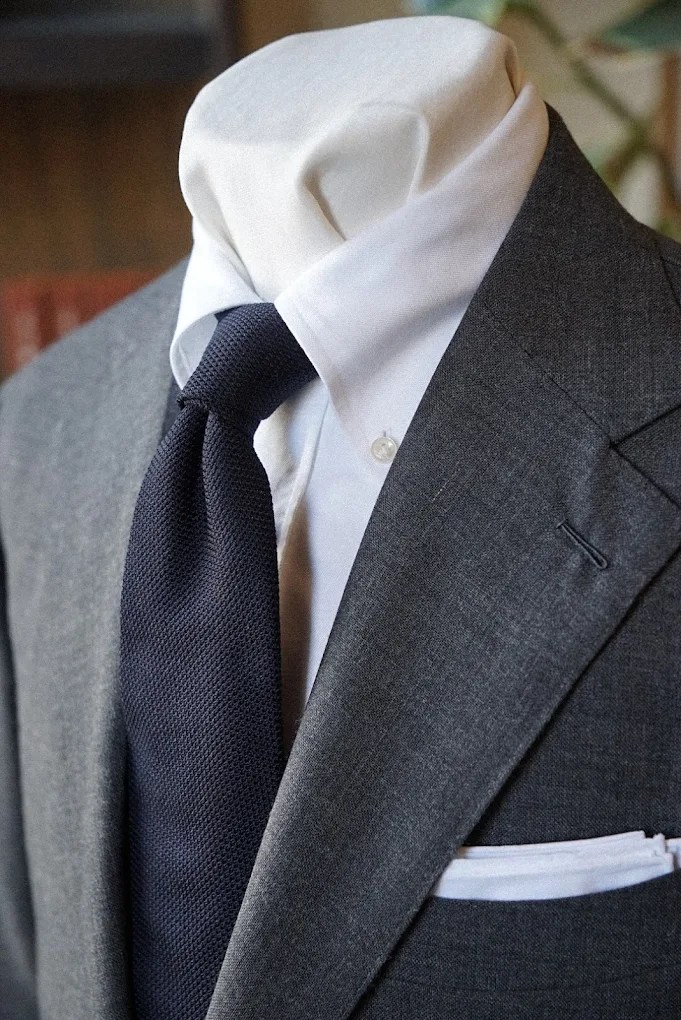
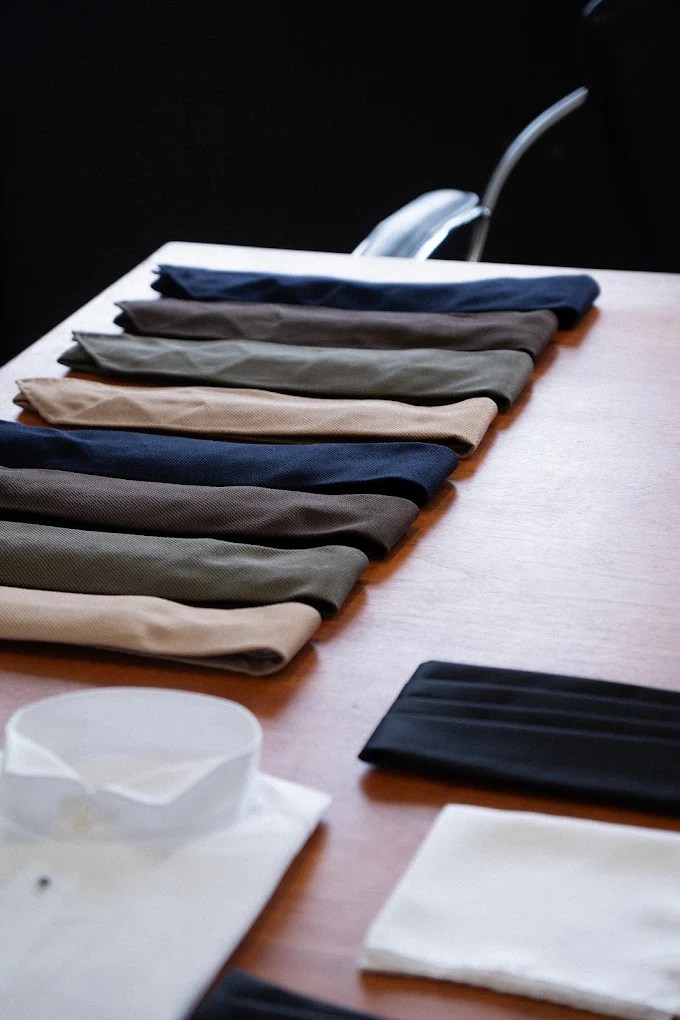
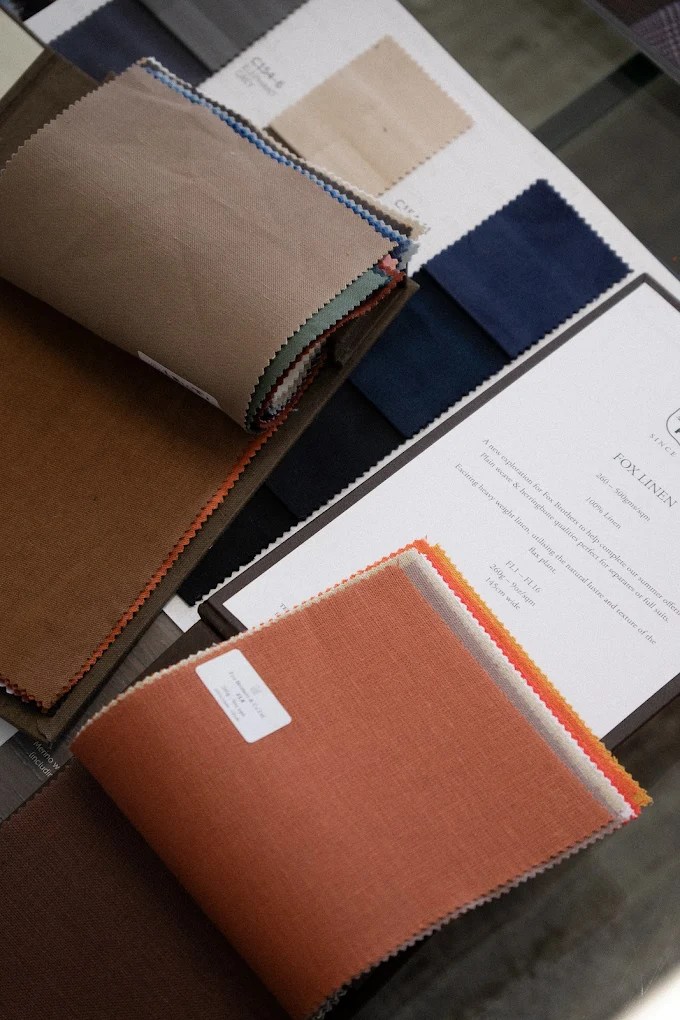
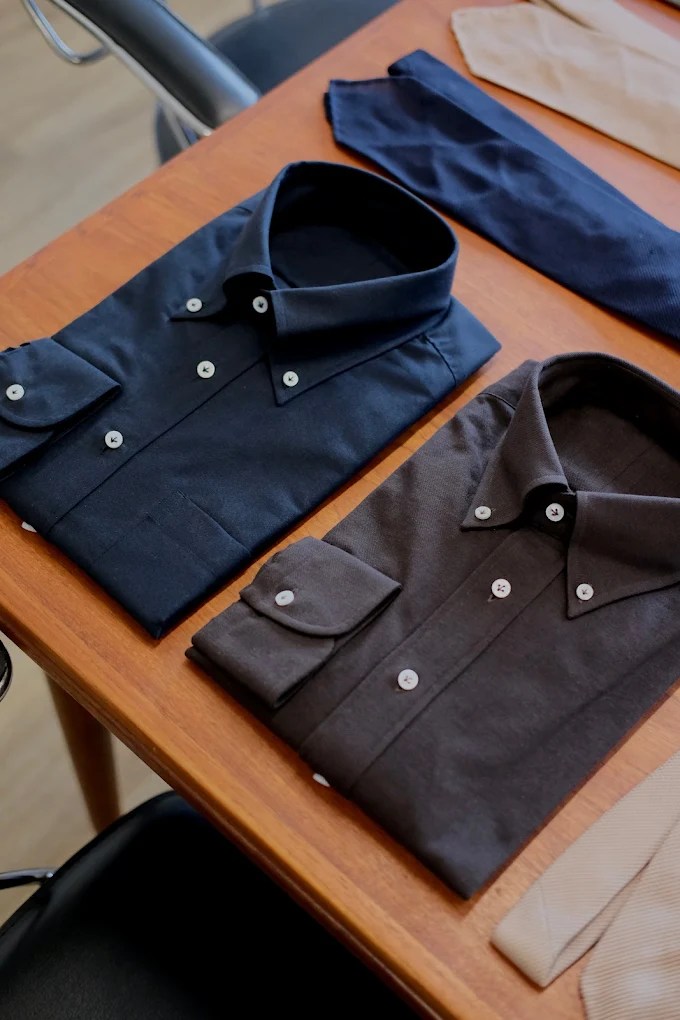
The Revere carries the best. Solbiati sits beside textiles from the likes of Dormeuil and Dugdale Bros & Co. Worsted wool whispers between your fingers. Complex tweeds. You flick through linens and cottons and alchemical blends, Steve offering an erudite commentary on the pros and cons of this weave or that pattern, his experience mingling with your imagination. Houndstooth. Window panes. Cool tones vs. warm. Hand feel. Climate applicability. This is the ground you traverse like explorers, discovering possibilities which are, when you think about it, different realities moulded around choice of fabric and colour.
Then you stand before a massive mirror, trying on blank trousers and shirts, their different sizes zeroing in on your shape. The talk shifts to fashioning drape and breaks and collar and cuff circumference to accommodate a watch. Steve studies the ensemble with a practiced, all-encompassing eye, pinning here and tugging straight, a sculptor drawing the idea from the unformed stone. And you, the stone, see it happening in real time. The way the line of your back appears. How your legs are smoothed and elongated. The word here is “refinement”. After this fitting, the last details are hammered out and entered into your notes.
Placard: front.
Buttons: tortoise shell.
Botton down: no.
Monogram: yes.
Side adjusters: yes.
Cuffed trousers: of course.
Consultation finished, you shake hands, leave, wait six weeks. And in this wait, discover that time is want to bend, contract, and stretch, the initial consulation and the fitting to come acting as parathetical events separating tailored time from the continuum’s basic flow. Thoughts bend towards how the clothes will turn out. How you will look in them. The outfits they will spark. What shoes will match the trousers. If the shirt can be dressed down. The intervening day blur and elongate, seeming snail-slow then swallow-fast as they countdown … and then, the day arrives and you return, shake hands, and witness the sewn rendering of shared thoughts into cotton and stitch. A pair of chocolate brown trousers and a navy blue shirt wait on hangers. Steve’s invocation of timeless style resonates with the building and the past it still recalls, placing The Revere within the history Eltham is quick to frame. He writes:
“As late as 1961, textiles, clothing and footwear still accounted for 15 per cent of all Australian manufacturing employment; in Victoria, the most industrialised state, this figure was higher. Much of this rag trade was centred in and around Flinders Lane, the heart of Melbourne’s garment district.”8
This historic pedigree flows through building, into The Revere, its form conducted by Steve into the garments you now try on for the first time. Note the fit of the shoulders, the taper from chest to waist. Remark upon the length of the inseam and the way the legs almost seem to float over your skin. In profile there is an image of you in the mirror which did not exists before this moment and will now never stop existing, the clothes suddenly and subtly an extension of you. Through this you feel as though the building’s history and the realities its occupied have been pinned to your own, your personal story adding a few lines to be dense prose of ten storeys by virtue of Steve an his wish to “to deliver garments that are authentically you, authentically The Revere”9. Said garments are then carefully hung on a heavy, glossy hanger and stowed in a white garment bag emblazoned with the maker’s name in bold, black lettering.
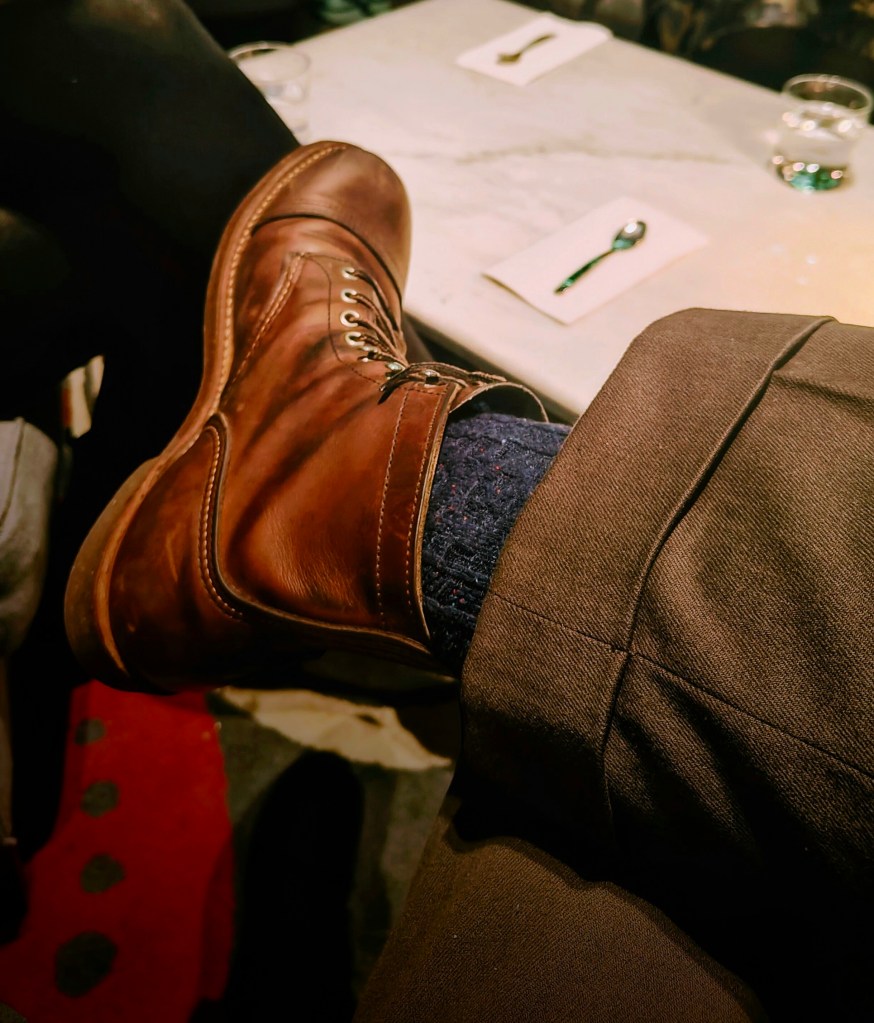
Cotton trousers from The Revere
Red Wing Iron Rangers in Amber Harness leather
Stepping back into the jumble of Flinders Lane, you take a deep breath, wondering if the whole experience has been some kind of phantasm. To some degree, to walk into the Nicholas Building and The Revere, is to walk both into and out of time, liberated from the CBD–the rush, crush, honking din–by a stiller, calmer, more deliberate arrangement of the things that lend Melbourne its character, if not charm. Snathes of idle conversation and bluetooth phonecalls rise and clash. Delivery cyclists swerve. As a relatively young city, Melbourne’s past is less about its stone edifices and more about the people you walk past or work within them on a daily basis. The famous laneways and arcades are beautiful, yes, but they are beautified by the graffiti artists, cafe owners, and store holders who convert the grid of urban passages into a twill of meetings, encounters, brunches, memories, and relationships. And this is what you carry away in The Revere’s garment bag and what you inhabit when you wear and re-wear its tailoring.
- Eltham, B 2010, “The Nicholas Building: A User’s Manual”, https://meanjin.com.au/essays/the-nicholas-building-a-users-manual/, accessed 10.02. 2026 ↩︎
- Delaney, B 2021, “‘The only place like it in the world’: why the Nicholas Building is the creative heart of Melbourne”, https://www.theguardian.com/culture/2021/oct/12/the-only-place-like-it-in-the-world-why-the-nicholas-building-is-the-creative-heart-of-melbourne, accessed 10.02.2026 ↩︎
- ibid. ↩︎
- https://www.nicholasbuilding.org.au/ accessed 11.02.2026 ↩︎
- https://www.merriam-webster.com/dictionary/revere accessed 11.02.2026 ↩︎
- https://thecontentauthority.com/blog/lapel-vs-revere accessed 11.02.2026 ↩︎
- https://www.therevere.com.au/about accessed 11.02.2026 ↩︎
- Eltham, op. cit. ↩︎
- https://www.therevere.com.au/about accessed 13.02.2026 ↩︎
 Narrative Gauge Sweater
Leave a comment