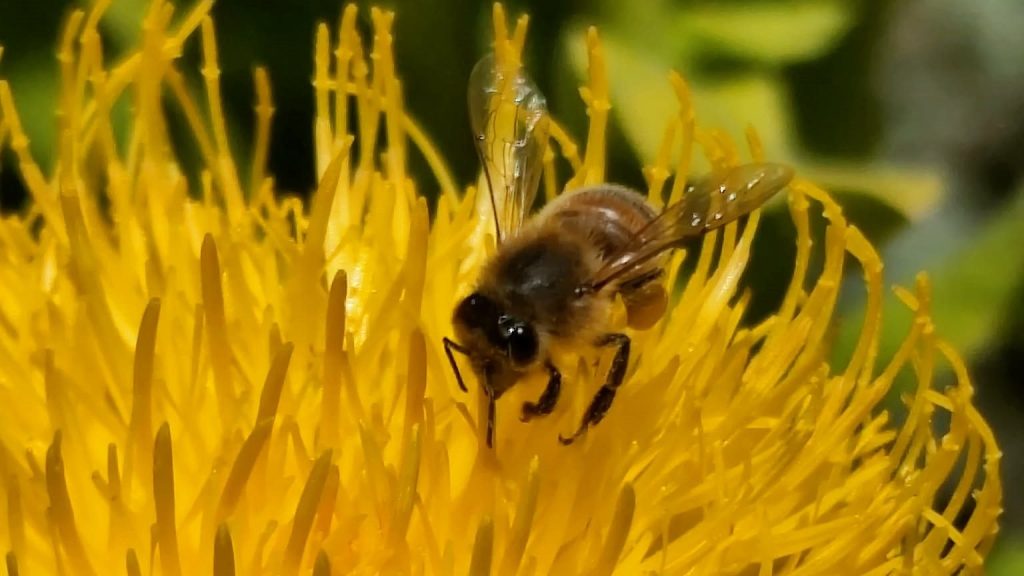
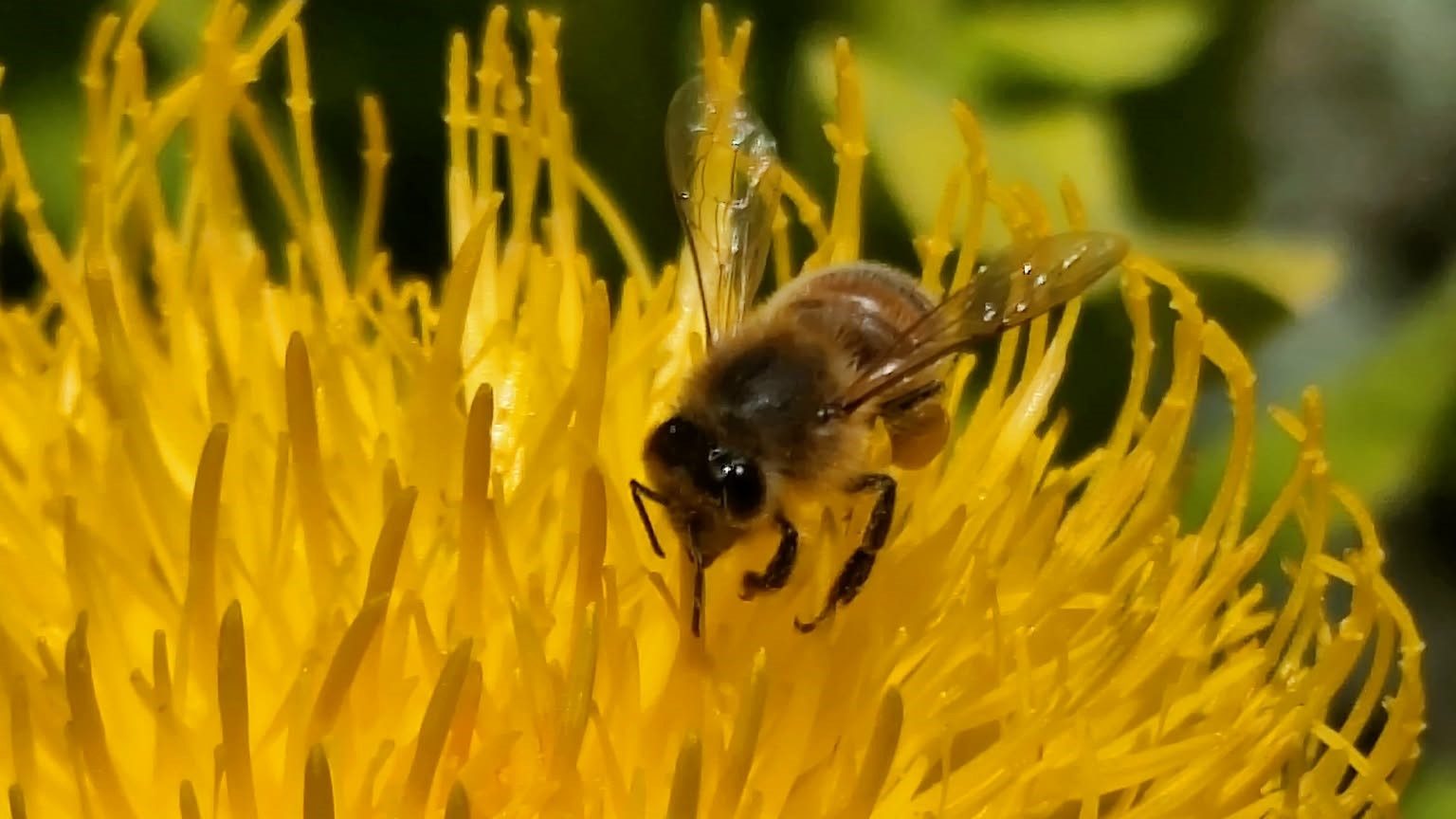
Having come to the place of its death, the bee stung the back of Kalahar’s hand then rolled into the water. The clipper rocked. Moored to a drooping streetlight, it creaked as the solar array crowning its flybridge tracked the dawn beyond the last three floors of a gutted accountancy. The air was sweaty-sweet. Smoke wafted from oily spot fires blighting the north. Blackened flotsam clonked against the hull carrying a tang of melted polymer, singed hair, and cordite. Carefully, she plucked the stinger and sucked the rising weal. The hives murmured anxiously.
Kalahar took a bite of the toast in her other hand and chewed thoughtfully, catching the crumbs on a melamine plate. Around three in the morning she’d been woken by reports of gunfire. Wrapped in a blanket, she’d emerged from her cabin below, boiled the kettle, brewed a mug of peppermint tea, doused all light, and watched from the stern. Gunfire metastasised to explosions. Jets of yellow-white flame. Then, nothing. By the time sunlight cut the horizon, evidence of the distant violence appeared: spent cartridges, chunks of hull, a propeller blade, bodies. Kalahar peered over the side just to make sure, finished her toast, and returned to the galley. Plate in the sink, she reboiled the kettle, a few stray bees flying gyres in the steam. Plastic pots of honey on a central table cast the sun in golden geometries about the narrow saloon. Threadbare upholstery on padded bench seats patched and repatched. Veneer panelling matching wood strip parquetry. The kettle dinged. She sighed.
“Apis mellifera. The humble honeybee,” she whispered, the words like a calming mantra. It wasn’t her job to do anything other than ferry them from place to place, sourcing pollen for the hives crammed into the flybridge, maintaining some semblance of biodiversity. She’d made the choice to eschew the CBD with its towering wall of braided eucalypts and the cosmopolitan barnacle of Styrotown stuck to its side, embracing a nomadic existence in the used-to-be inner suburbs. Whatever they did, whatever they wanted, meant nothing to Kalahar. Hers was a different duty bordering, if you believed in that sort of thing, on the sacred. Because the world was fucked up. Fucked up bad, because they had fucked it up, and Kalahar was doing the only thing she knew how in the misguided attempt at unfucking it. Even so, she went below, disconnected her music from the charger, retrieved a song, went astern, and lifted a hooked pole from one of the chromed uprights of the weather shield. Caught on the swim platform: the body of a girl, small, no more than four or five years old. Kalahar prodded it.
“Man up, hold tight, diving darrrrrrrrk,” she sung under her breath, <JUSTICE> Women <Safe and Sound> scrolling across the cracked display of her antique phone. Bluetooth earbuds, more than worth their weight in bartered honeycomb pumped bass under treble. Both the phone and the song were somebody else’s, long gone, their eccentric playlist all that remained. “Head up, foot down, speed of souuuuuuund.”
Poke. Even at the end of the world, a beekeeper’s life was defined by patience and pain. Poke. Poke. Sometimes you got honey and sometimes you got stung. Poke. The girl’s eyes snapped open. Two dilated pupils, each a void within a glowing amber iris. Her white hair was a sodden dandelion. Poke.
“Hi,” the girl croaked, delicate hand clasped around the pole. Something off with the voice as if each letter were chopped out of sentences uttered with different accents. “Permission to come aboard?”
***
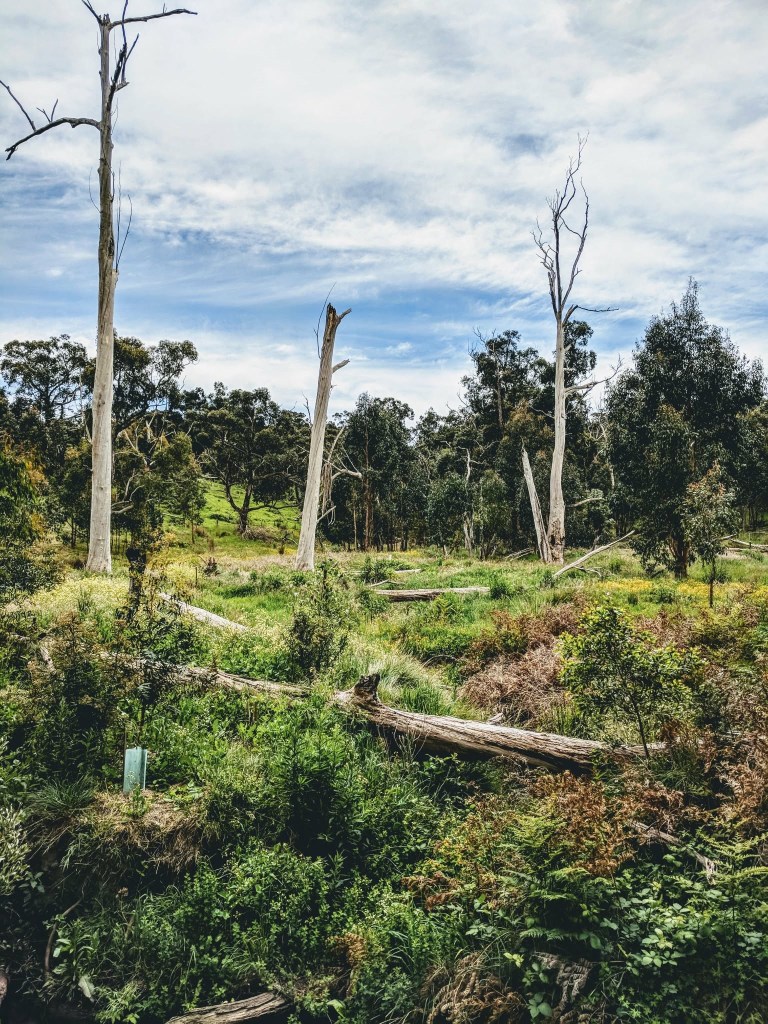
You stand at the edge of the forest. Huge trees sweep over folds of an undulating valley, rendering down its topography to a gentle unknown. On the border, you hesitate, sniffing the air, straining to discern tell-tale noises, thinking that there will be something to give away the nature of this wooded place. No birdsong. No scuffle-huff of unseen marsupials. No human industry. A rising smell of damp, cold soil. Between the trunks a dappled light that, when considered, seems to issue from a host of different points. You stare at the sky, shielding your eyes. There is sunshine and only sunshine, without blue, absent cloud. The sea of emerald leaves shiver in susurrus. It sounds like a conversation carried out in hushed, rushed tones. A space of thirty centimetres separates you from the nearest tree, grey bark almost silver with green bruises, cool to the touch in the way of old, thick trunks, slight wrinkles capturing the climates of his history. Like this, fingers to bole, a decision is made. With the first step, leaves crunch underfoot. You don’t think to look back. There is nothing but the forest.
***
“I don’t know why,” said Kalahar, weary and stiff. Hands flexing on the helm, she nudged the clipper past a fractured branch jutting from the water. Preening on the glass dome of the ship’s compass, the bee wobbled from side to side, inscrutable. Shadows stretched along their vector, the sun behind polishing the gentle ripples gold. Beneath the surface, she tried to picture the tight grid of streets with their sardined shops, houses, schools, and parks. Once, her mother had told her, a trainline had stretched away from the city, following and intersecting the Yarra River years before the tides had risen and the treewall with them, cropping out what remained of the metropolis from a drowning country. Building tops appeared, here and there, concrete puddles thick with lichen and scabbling cockatoos. Apartments stared back though broken windows. Ancient graffiti spoke entropy with faded tags. Lily pads flourished. “Why do I do anything?”
Asleep on the bench seat behind her, the girl whimpered then called out in different languages—English stuttering to Mandarin, Thai, Hindi, the words slurring then shattering as Romance tongues broke against German—which Kalahar recognised but didn’t understand. She rolled under a frayed gingham blanket, calm again. Kalahar frowned, gripping the helm tighter. Since fishing the girl out, they’d been stitching a thread east, away from the CBD, away from whatever it was that had belched the child. All day the propellors spinning to a nine-knot limit, the whitewash in their wake hissing distance.
Why do I do anything? The bee was an answer in itself, of course, its very existence lending something approaching meaning to her own. Her mother’s bees. Her grandmother’s bees. Multigenerational lives grafted to hives and boat whose hull, if you squinted close enough, still proclaimed itself the Thriae. A modest vessel for an immodest mission, her mother had said, just like her mother before her. Always with a smile. Always with a sigh. Kalahar didn’t think it bore repeating these days and simply got on with it. And, she argued to herself, it wasn’t because there was nobody to say it to.
She glanced back at the girl and shrugged tense shoulders. “Because it’s the thing to do.”
The child was running a fever, sweat plastering her fringe. When she’d conked out, Kalahar had checked for injuries and applied a film of propolis to a couple of shallow cuts. Eyes roved fitful under darkening lids. More words. More voices. Finished with its ministrations, the bee bobbed once and took wing. Elongated shadows announced the evening. Sporadic chimneys breached, putting Kalahar in mind of stunted periscopes. Dead trees reached, branches clawed into spindle fingers. The currents glittered with broken glass and oily effluvia. Ducks honked. The clipper pressed forward, sliding through this ruined impression of Richmond which was nothing more than a moniker in a book of multicoloured maps she’d bartered off a kelp farmer for a tub of beeswax.
“Where are … am … I?”
Kalahar looked over her shoulder. The girl was sitting up, swaddled like a caterpillar in a checkerboard pupa. “On board my boat. There was an explosion and here you are.”
For whatever reason the girl seemed to accept this as explanation enough. For a while she just sat there, staring through a no-place, blinking in rapid, disjointed sessions. Tears welled and trickled. Tilting her head back, she took a shaky breath then closed her eyes. “What … am I?”
Kalahar returned her eyes to the prow. “You don’t know?”
But the girl was asleep again, a bee on her cheek, ecstatic in her tears. She’d been weeping sap.
“The thing to do.” Kalahar’s knuckles were white. When the sun went down, they’d keep pushing with the batteries all through the night and into the early hours. Maybe a little longer. “Yep. Yep. Yep.”
***
The tree spears fifty metres into the sky and the name pops into your head—gum-topped stringy bark, alpine ash, woollybutt, eucalyptus delegatensis. You’ve never heard of it, let alone see one. The knowledge wasn’t there and then it was. This does not worry you. Maybe it should, but you are too absorbed in the tree to notice that the gap between the tree and the tree’s information does not exist. Its leaves are elegant crescents, the bark rough, stringy, mousy grey and something approaching Pantone 7410 C. Again, this data materialises as it is needed, the space between thought and recall nearly instantaneous, so too the fact that this colour is comprised of RGB 254 173 119 and CMYK 0 35 54 0. It is a lovely tone. Gumnuts are scattered about tree’s lignotuber in clusters of four and five. Standing close, it smells fresh and woody and cold, and when you hug it, the hierarchy of its classification unspools with a vertiginous alacrity.
Plantae.
Tracheophytes.
Angiosperms.
Eudicots.
Rosids.
Myrtales.
Myrtaceae.
Eucalyptus.
Eucalytpus delegatensis.
Geoff.
The tree’s name is Geoff and it is thrilled to have somebody to talk to.
***
“What did you say her name was, Kal?”
The Bunnings Junction roiled with activity, the cavernous warehouse thrumming with competing voices. Dozens of boats were roped together alongside rickety pontoons and makeshift piers, each one packed with different goods and professions. Hammocked stalls hung from the roof girders trailing rope ladders and aluminium buckets. Deals were shouted, exchanges bargains over calloused handshakes. Possums in possum boxes looked down as sleepy witnesses. Kalahar had crept in late, easing her way through the press and found Lommy Air Max, the unflappable sneakerhead displaying his latest reclaimed retros from a cabin cruiser painted black with a white tick. Stick-thin and sun-pocked, he stared down at the sleeping girl.
She shook her head. “We haven’t got that far.”
“How far did you get?”
“Questions, actually,” she replied, stretching out her back. A drumline of rain on the warehouse’s steel roof. Commerce boiled around them, sampans and rafts dodging old steamers and teams of coxless quadruple sculls. A nexus for nomads, frontier farmers, tradies, land carers, and eccentrics, Bunnings Junction was the place to find everything you needed and then some. Eggs were sold beside seedlings and scrap metal, scrounged bricks and pavers, repurposed timber, tools, bread, dried seaweed, hemp products, mushrooms medicinal, fish, yabbies, deep-fried insects, clothes, and all sorts of services for hire. At its centre, the ritual sausages were being sizzled with onions and homemade tomato sauce. Yes, a place for finding, but also getting lost. On the mezzanine level and up the paralysed escalator families had pitched tents, parents sitting around butane camp stoves while their kids played chasey. “Permission to come aboard? Where am I? What am I?”
Lommy blinked. “What am I?”
Kalahar nodded. “What am I.”
“Already existential? Heavy.”
The girl shook her head and mumbled something in Tagalog. Accepting a jar of honey from Kalahar, the sneakerhead hopped back to his boat and busied himself with a few guys hunting for kicks with Gore-Tex or anything in a size fourteen. Lommy talked shop in an antediluvian dialect chock-full of primeknit, single-bootie construction, torsion plates, zoom bags, traction patterns, fits true-to-size, break-in period, OG colour ways, and boost, always boost. As he did, Kalahar shuffled around her passenger, gathering honeycomb, royal jelly, propolis, and beeswax on a folding card table.
After Lommy’s customers left, she asked, “Any grumbles about a kerfuffle early today?”
Silently mouthing kerfuffle, Lommy pulled at a pierced earlobe. “Spooky stuff, mostly.” A quick glance about. Their boats had drifted towards the rear exit. Heavier now, the rain was a cannonade. A pair of thatched kettuvallam tracked by trailing a fug of marijuana smudged bronze by a lank curve of paper lanterns. “Stealth boats and bodysuit ninjas rocking proper ordinance. Some McGuffin that blanked nearby electronics that has Amber Mind written all over it. Making folks real nervy. Why do you ask?”
“No reason.”
He stared at her. “When did you say you picked up your little friend?”
“Must be a lifetime ago.”
“Funny.” The earlobe was getting a workout. “Saw you last week. Definitely sailing solo.”
“Lot of seconds between then and now.” Thunder shook the building. Ripples spread across the water, met, cancelled out. Shadows tore over cataracted skylights. “Lot of lifetimes.”
He nodded. “I feel that. Here today, deady bones tomorrow.”
Kalahar grinned, mouthing deady bones.
“Water. Thirsty.” The girl was sitting up, massaging her cheeks. Kalahar popped her head into the cabin and opened her mouth, but the girl pointed up, amber eyes wide with terror. “They’ll kill everybody!”
A dull detonation tore through the roof, showering the Junction with metal and plastic. Ziplines spilled down, followed by smoke grenades and cherry laser sights. Engines sputtered and water churned with oars. Bodies hit the water and were lost. Gun drones flowed through the front entrance, dipping and flitting through the chaos. Without a word, Lommy and Kalahar gunned it into the downpour, eardrums ringing as the bullets chewed.
***
You are walking, walking between trees, walking and walking under rustling shade. The air warms. Sunlight from different suns, from different days, and other hours cuts your path into the fractured geometries of a kintsugi vase. Having abandoned the outer remit of the forest, you’ve discovered a denser, wilder habitat dominated by the gorgon-headed roots of Huon pine. The undergrowth crunches. Methyl eugenol slicks every breath.
“Lagarostrobos!” you call, clamouring over a precarious landscape carpeted in moss. Myrtle competes for space. Broken stumps sprout huddles of tiny mushrooms. “Lagarostrobos!”
The name carries then dissolves. The voices are louder now, but they are hard to parse. They are not talking to you, preferring a polyphonous chatter that continues in a sibilant round. Huon pine has been known to live for over two thousand years a fresh memory informs, so it is to be expected that they have a lot to say, especially to one another, the antique spirits sharing ring after ring of collected centuries. Their roots reach, touch, seem to knot as if each separate tree is an extension of a singularly colossal organism. The thought, and you don’t know if it is yours or not, is as compelling as it is melancholic, the nostalgic chorus reduced to an abstracted intelligence speaking to itself.
You pause … without thinking, you’ve been parroting the voices, the brain absorbing and perceiving what the mind cannot. Hands clamp over your lips. Cold and smooth, their fingers grip your cheek and squeeze. Pain. Bone creaks. They block your nostrils, igniting the oxygen in your lung to an aching fire. You panic and whirl around. No. Nothing. The hands release and drop. Your hands.
Just ahead the forest is bisected by a shallow stream. Water runs fast, an endless glass pane sitting on a pebbly bed of smooth volcanic glass. Standing up to your ankles in the current, you watch as your reflection wavers and splits, one of you turning back, the other fording on. The water has no discernible temperature which means, you deduce, that it precisely matches the temperature of your blood. The obsidian stones are dilated pupils without focus. Just holes opening wider and wider, and you are falling, flailing, submerging, the distinction between water and skin non-existent, your ending, your beginning, your heartbeat a metronomic sonar adumbrating absence and itself.
Gasping and dripping on the opposite bank, you sit back on your ankles, hugging yourself as you shiver and sob.
“Welcome, child,” says a giant echidna materialising before you. Around it, the forest warps and contracts. It snuffles at you and scratches its stomach. “It’s lovely to meet you, please call me Crick.”
***
The hunter watched the recording back through the splice in his optic nerve, the picture grey-green diffuse from the drone’s night-vision lenses. He fast-forwarded and stopped, listened to the conversation, and fast-forwarded again. Around him, the febrile night. More than a kilometre away, the drone maintained its hovering vigil over the target. Water licked at his feet, creeping over the lower edge of the PWC, beading on black hydrophobic paint. Curious fish breached, splashed. Pausing the footage, the hunter performed a series of muscle-tension exercises that started from the fingers and, group by group, descended to his toes.
Play.
“I always liked the classics, you know?” said the target, turning an old runner in its hands, pattern recognition software suggesting Air Max 1 with ninety-eight percent probability. The directional microphone made the words crisp, overly loud. The two boats moved together, tethered close enough that they almost read as a single vessel. The drone dropped twelve metres, improving the angle. “Tinker Hatfield sitting in front of the Pompidou having the brainwave for the exposed bubble, right? Genius.”
The man, DNA sampling specifying a Kerela extraction twice removed, snapped his fingers. They were sitting on his boat, opening shoeboxes, handing shoes back and forth in the dim light of a wind-up lamp. “Preaching to the choir, little sister.”
In the other vessel, the woman was obscured in the flybridge. The drone switched to thermal, painting her and the hives a spectrum of yellow, orange, and red. Bees zipped into the darkness and crawled over the boat. They were in her hair and hands as if she were part of their ecosystem. They had intercepted every attempt the hunter’s drone made at sampling her genetic material. Territorial. Aggressive. Humming to herself, she worked, repairing dead scales on a narrow solar panel. The drone had tagged the song—A-ha: “Take Me On”—before flicking back to the target.
“Give me an air unit any day.” The target placed its hands together as if in prayer. Handing the target a plastic bowl of kangaroo jerky, dried fruit, and flat bread, the man nodded eagerly, chewing his own cold dinner. “Ninety, ninety-five, ninety-eight. Straight bangers.”
Swallowing, the man said, “Viotech, volt, and the Wotherspoon.”
The target offered a hand which the man promptly slapped. “Reseller’s delight!”
Pause.
Leaning back, the hunter considered the vision, the picture remaining fixed even as he moved. Switching to the live-feed, present reality snapped back to perception, his sense of it skewed slightly by the drone’s elevation. A GPS and electronic compass glazed him blue, the illumination sluicing over the gaunt lines of his wetsuit. Another readout blinked into life. Reflected letters and number scrolled over his clean-shaven face, deforming over the dermal scarring where the eyelids had been laser sealed. Even backwards, the encrypted orders were clear: MISSION PARAMETERS UNALTERED: SECURE TARGET: GAMMA DESCION TREE: INDEPENDENTS OF NO CONCERN. The drone rotated skyward. A few pin-pricking stars caught between the clouds. The hunter returned to the recording.
Fast-forward. Play.
“This honey.” The drone maintained a perpendicular line of sight. The target and the women were settled in the main cabin, shoulder to shoulder under a blanket. On the other boat, the man snored. On the central table: an unpowered phone, earbuds, a bronze incense burner, seven bees, and an opened jar of honey. The target had a teaspoon in her mouth. “I can taste the places and the faces of it.”
“When you woke up, you asked me what you were,” replied the women, frowning. The drone zoomed in on her face. Facial recognition failed. Muscle-Wrinkle-Pupil mapping diagnosing fatigue, dehydration, pain, simultaneously hypothesising high-level anxiety, low-level fear, and potential inner-turmoil consistent with memory engram access. “You told Lommy that your name is Brachychiton. That’s one of the original Amber Minds, isn’t it? The one governing Lonsdale Street?”
This was flagged and squirted via priority one to the hunter’s handlers.
“Yes.”
“What are you?”
“I don’t know.” The drones tracked the target’s face, MWP software drawing a blank, the staggering amount of data she subliminally transmitted acting as some sort of computational static. Verbal stresses, isolated and replayed and decoded, posited that the response signified secondary, tertiary, and quaternary conversations. The target licked the spoon clean and offered it to the woman who, after dipping it into the honey, twirled it several times before placing it on her tongue. “Something was done to me. A process. I … there are voices. So many voices.”
The woman swallowed. “What were you doing out here?”
“There was supposed to be a handoff.” More tags were applied to the conversation and relayed. “An exchange of technology. I was, I don’t know, a proof of concept, I think.”
“What concept?”
“A … seed.”
New orders superimposed over the recording. MISSION PARAMETERS AMMENDED: SECURE TARGET: OMEGA DESCION TREE: NO WITNESSES. In the darkness, the hunter grinned.
“What did you mean about the honey?”
“Everything is information,” said the target, resting its head on the woman’s shoulder. It yawned. “You just have to know how to read it.”
***
Even though Crick is an echidna, what it certainly isn’t is an echidna. You know this because Crick told you it was an integrative carrier sequence, and when you asked Crick what that was, Crick happily simplified: a biological program. The moment those words were spoken, you also knew that Crick was named after Francis Harry Compton Crick who, together with James Watson and Rosalind Franklin, was lauded for decrypting the helical structure of DNA. When you understand this its significance becomes disquietingly clear. The forest, the tree, the stream, the echidna are not elements of a dream—they are real, insofar as representations, psychopomps, and subconscious constructions are real. And once this thought crystalises it is the first in a steppingstone of further realisations. You are lost in your own mind. You are changing. You are being changed. You, amongst all the stuff you never-knew-have-always-have-known, cannot recall your own name.
“What’s my name, Crick?”
The giant echidna slows, glancing back at you. “My sincere apologies, but I lack that information.”
“Do I have a name?”
Crick looks away and bristles slightly. You’ve learned that he dislikes saying no. “Not to my limited and specific awareness.”
Between one step and the next, the forest changes around you, the sudden shift in its gestalt like a perceptual vertigo. Stumps appear, their boles rough cut or hewn, the smell of sawdust earthy and sweet. Crick picks up the pace, eyes furtive, spines out. Through the distant trees, shadowy figures swings axes and push-pull elongated crosscut saws. Timber cracks, screams, and booms to the forest floor. There is no reverberation. You don’t feel the impacts. A large termite scuttles across your path. Then another and another.
You squat to watch the insects as they climb over the stumps. “What are they?”
Crick hops from foot to foot, careful to avoid any contact them. A darting tongue tastes the air. “Antibodies.”
“But this is happening in my mind?”
“Alfred Korzybski famously claimed that the map is not the territory when discussing the relationship between an object and its representation. He was interested in the degree to which individuals confuse models of reality for reality.” You stand and Crick stomps off, dragging you in his wake. Other trees are plagued with fungal infections, knots blown out like popped cysts, green leaves splotchy with orange and yellow. Staring at them gives you a headache. There are implications to this that you don’t pursue. “In your case, this isn’t, strictly speaking, true.”
Crick’s explanation is annoyingly opaque, a thought that, you are sure, you wouldn’t have had a moment ago. That, however, doesn’t stop you from having it. “That’s annoyingly opaque.”
“My programmers leant towards erudition in exposition.” As instantly as the antibodies manifested, they vanish, the forest returning to its dense uniformity. Your headache recedes. “Apologies. While it certainly is happening in your mind, it is also happening in your brain.”
“What is the forest?”
“The forest is object and the representation of the object,” says Crick, its voice calmer now that he doesn’t have to dodge termites. It catches you glowering. “Yes, a thousand apologies. A seed was grafted to your hippocampus. That seed is a facsimile of an Amber Mind taken at the moment of the seed’s production and implantation, replicating the Mind’s networked bio-circuitry and memory storage/recall assemblage.”
The description settles over your consciousness, the smooth surface of it folding and creasing, the outlines of a memory sticking up beneath it. Darkness. Damp air. Dripping water and hushed voices. You’re scared. Terrified. Crying quietly. Warm hands on your shoulders guide you down metal stairs. You want your mother. Your father. But they were poor and hungry, and they sold you for as many tomorrows as they could.
“An Amber Mind.” You shake your head, and the memory desquamates. Data takes over—the Amber Minds in their arcology towers, each organic intelligence nurturing and directing its inhabitant citizens with the surety and subtly of master gardeners whose competing designs, pruned and propagated, pollard the futures of the CBD and Styrotown. Collins Street: Pinus. Exhibition Street: Araucaria. Exhibition Street: Salix. Bourke Street: Jacaranda, Spring Street: Aesculus … “Which one?”
“Brachychiton.”
The name echoes in a million different voices. Brachychiton. Lonsdale Street.You shiver. The name now spoken becomes your name as if it always was. “And what is it doing to me?”
“The map is the territory,” replies Crick and, you make yourself believe, the words are doleful. “At least, it will be.”
***
Kalahar sat in the flybridge tending to the hives in the evening cool. She scooped handfuls of bees and let them crawl around her knuckles. A placid hum. The hives, three tall, wood-polymer boxes stood around her, bees coming and going with a seeming randomness that belied their regimented intent. She checked the humidity and ran an acoustic analysis through the hive’s many inbuilt sensors. All green. All optimal. All good. Branches reached over the water, leftover trees from some long-ago footy club circling the boats and the shattered roof of the member’s rooms. She sighed. Kalahar loved the bees and their hives like one loved a house and the people who made it a home.
“Apis mellifera,” she said, turning to watch Lommy stack and restack his sneakers. The sun was only an hour retired. A battered paperback sat closed on top of the central hive, Forces of Nature by Brian Cox and Andrew Cohen. It was missing the back cover and a few of the final pages. “The humble honeybee.”
The book was her grandmother’s. Her grandmother had been a scientist in the CBD. And while she didn’t know what kind of scientist, her mother never having told her, the basic fact of this profession possessed an onion of connotations. Elite. Wealthy. Authority. Melanoma free. Saviour, but only to the select few how calling themselves citizen. She was someone, amongst a lab-coated clique of someones, who kept the urban parcel once known as Melbourne breathing, heart beating, drinking, recycling, eating, composting, fucking, pissing, and shitting. Until she wasn’t. Until she packed her bags, scaled the treewall, stole a boat, weighed anchor, and departed her old life with an infant daughter and a buzzing imagination.
When Kalahar was growing up, her mother told the stories her mother had told her, stories she, when she had a daughter of her own, now told in turn. Because she, like her mother, was also a scientist and because books were as rare a commodity going around as any. So, the only stories both her mother and Kalahar heard were those wonderful tales spun by Messrs Cox and Cohen about the startling beauty of the natural world.
Their favourite ran like this: Kepler, interested in the sculpting of snowflakes, investigated the construction of honeycomb, hypothesising that both were built by a form of agency. Darwin, entranced with his theory of natural selection, did the same, viewing honeycomb as a most exquisite example of animal adaptation. Later, William Bernhardt Tegetmeier designed an experiment which contended that honeybees first build cylindrical cells that they then modify to hexagons as this shape was the most economical method for storing honey. Of course, natural science, just as the world it described, did not stand still, but strode forward in the shoes of three engineers by name of Karihaloo, Zhang, and Wang. Filled with poetic sensibilities, these modern pioneers claimed that the honeycomb’s hexagons were a result of the bees’ body heat softening the wax. Warm enough, the wax would flow and meet like soap bubbles at an angle of one hundred and twenty degrees which, cooling, would reform into hexagons. For Cox and Cohen this was the most elegant answer to a small, yet engrossing question: “The bees allow physics,” her grandmother and her mother would read, “to finish their work.”
The inverse of this sentiment—the proclamation that all that was awesome and inspiring depended upon the relationship between the world and the entities inhabiting it—shattered Kalahar’s empty thoughts as flash of green then a white, zipping streak, exploded Lommy’s head. A cloud of brain and blood and skull as his body flopped right with the bullet’s inertia then toppled over the side of the cabin cruiser. A splash, then nothing. Brachychiton shouted something below and fell quiet while, around Kalahar, the bees rippled in alarm. The boat’s engine coughed into life.
“Do not move,” said a voice from above, the words digitised and distorted. A quad-rotor drone descended to eye level, an arachnid lens array whirring into focus. The green line of a laser beamed onto centre mass. “Join the collateral in the flybridge. Slowly.”
“Apis mellifera.” Kalahar tried to swallow. “The humble honeybee.”
The drone buzzed closer, eyes clicking, dilating. Agitated, the hives’ harmonics glissed higher. Bees shimmered. She could hear the girl stomping over the deck towards the flydeck. Lommy’s boat bobbed and drifted. A spray of Lommy on the hull. A few bubbles popped on the surface. The hovering machine was almost close enough to touch. If she could reach it … Kalahar leant forwards and the laser snapped onto her forehead.
“Do. Not. Move.”
She squeezed her eyes tight. Images of Lommy as mist. Misted. Blood as vapour. “Apis mellifera. Apis mellifera. Apis mellifera.”
Cool fingers prising her fist apart, giving her hand a squeeze. “It’ll be alright, Kalahar.”
“Apis mellifera?”
“Yes, the humble honeybee. Just keep repeating it and it’ll be alright,” said Brachychiton, mosaic voice all soothing tonals. Kalahar opened her eyes. The girl was smiling, amber eyes sad and kind and old. She was wearing one of Lommy’s holey tees, screen print of the 1991 NBA Finals Chicago Bulls chipped and faded. It was three sizes too large. In her other hand, a glob of propolis. “Trust me.”
Kalahar nodded, trying not to move, waiting for her own head to explode. A few bees detached from the hives, scouting the drone. She needed her music. She needed to scream. Needed to pee.
The girl sniffed the air and whispered, “What happened?”
“Happened?”
Another squeeze. “Lommy.”
The drone dropped towards Brachychiton and Kalahar felt that strange tickle down her neck and back that she always got when a dentist was poking around her mouth. A syringe extended from a port near the left front rotor.
“Step towards the drone,” it said, flat and clipped.
Apis mellifera, Kalahar thought. “Lommy. Green. White. Gone.”
“Ok.” Brachychiton detangled from Kalahar and took a step, hands level with her shoulders. The propolis gleamed. “An anti-defilade wren.”
Kalahar frowned. Sometimes, most times, it was all a little much and words, even words she understood, didn’t make any sense. “Wren? A bird blew up his head?”
“Laser-guided semi-autonomous explosive bolt.” Brachychiton stole another step, bringing her left eye in line with the syringe. That too-close-ick-get-out-of-my-personal-space sensation intensified. “Fire and forget system. Smart.”
On “smart”, the girl dropped under the needle before driving the hand with the propolis into one of the drone’s rotors, screaming as the blades sliced into her fingers. Blood and sap flowing down her arm, Brachychiton squatted, then launched up and sideways, legs jack-knifing into Kalahar’s chest, shunting her to the back of the flydeck and against the hives. Almost simultaneously, she double pumped and thrust the drone into the space recently occupied by Kalahar’s head which, catching the white blur of the wren, detonated. The girl’s hand went with it. And some of her arm.
“Up you come.” With the hand she still had, Brachychiton brushed a few curious bees off Kalahar’s face and helped her to her feet with surprising strength. “It’s a distance weapon, but I’m a search-and-secure op. The hunter can’t be far away.”
“Your hand.” She couldn’t take her eyes off the stump or believe that it was a stump. An actual stump. Where bone and flesh had been blasted away the skin peeled back in bark-like strips, its underlying musculature hardened, splintered, more than slightly greenish yellow. A resinous substance with a sweet-nutty smell had already formed over the wound. “It’s … gone.”
“Yeah, I’m like Daft Punk,” said Brachychiton, waving the stump. A few, hair-thin roots emerged from the resin, waving in the air. A moment later, there were dozens more, twinning and braiding into a simulacrum of a circulatory system. Her skin had blanched pale and her whole body trembled. She grinned. “Harder, better, faster, stronger.”
Kalahar fought vertigo. Good song, but when had she had the time to listen to Discovery? “What are you?”
“Right now? I’m just a girl needing you upright and conscious.”
“Why?”
“Because my body is having a robust conversation around whether it is human or tree, and at the end of this sentence, I won’t be.”
And then she wasn’t. She was a weight in Kalahar’s arms and Kalahar was carrying her below and propping her against the bulkhead by the helm and slamming the throttle its full nine knots, leaving headless Lommy and his sneakers in all their creased boxes in their wake, picking stingers out of her face and neck as the clipper churned east.
“More than ever, hour after,” she sang under her breath, the lyrics an anchor to the here and now, refusing to look back, because to look back was to cop ones of those bloody wrens in the head, “hour, work is never over.”
***
You aren’t surprised that the forest has changed, but the extent of it proffers a reason to pause. The trees are gone, replaced by carvings. Men, women, children fixed in hundreds of poses stand or sit on stumps, captured in perfect, lifelike detail, each hair and wrinkle and smile and pimple retained in smooth, grey-brown bark. Packed sawdust made gold by resin wanders as a labyrinth between the carvings. Its centre runs with white mycelium. Crick takes it all in its stumpy stride. Crick would, though. Crick the integrative carrier sequence; Crick the biological program. Crick’s part of the problem. Your problem—the problem with your brain and the extent that it can still be called yours. The absent sky is white. You sniff the air. Pine. Wood chips. Damp, nutrient-rich earth. Sporing mushrooms. Faint whispers.
You pause before a young man with a fauxhawk, legs wide, left hand on hip, right hand outstretched. “Who are they?”
Crick quivers. “They are you.”
“You’d think I’d remember them.”
“They are the accreted data of the Amber Mind, accessible through the mycorrhizal network that has largely colonised your brain and is currently attempting to replace your nervous system.” As Crick talks you remember that you are largely talking to a version of yourself that is currently trying to assert control over every aspect of your physical and cognitive being. Effectively, Crick represents a you that is killing another you one neuron at a time. “Their bodies suffused with neural-conductive amber and then interred in the roots of Brachychiton, their totalities adding to its totality.”
Tentatively, you hover your hand over the carving’s fingers. Infinitesimal hyphae bristle up to meet you, seeking connection. “I don’t want to die.”
“You all die.”
“I want to die as me,” you say, pulling back. You move on, walking amongst these dead and buried figures that occupy your brain. Trespassers. Squatters. Making themselves at home even while they transform the very idea of themself/yourself/self. Faint pulses register beneath your feet. A warmth. The mycelium knows you’re there, tracking the movement. “Me, me.”
Crick snuffles. “Who are you?”
“I’m in here somewhere.” But you’re not sure of that. You were young, very young, when they slipped you the seed. Maybe you hadn’t taken root and were quickly, irrevocably crushed by this foreign host of Brachychiton. “I just need the chance to find her.”
A kneeling woman with kind eyes, hands held in namaste. You brush against her shoulder and the link is instant, all-consuming … and you are Tani, survivor remnant of the South East Asian diaspora, making chai near the apex of one of Melbourne’s towering archologies, the morning sun already scorching, clove, cinnamon, and cardamom almost-not-quite supressing the reek of your own sweat, prayer beads orbiting a bony wrist that aches at anything below twenty-three degrees, the cello music you’re composing blossoming in time with their quiet rasp and bubbling boil of the kettle. You …
The connection breaks as your shoulders part. Your feet are numb, legs stiff. Where your bodies touched, the same translucent hyphae. Undulating. Grasping. You blink and a termite appears on the carving’s chest, mandibles crunching at its shoulder. A dull ache behind your right eye.
Crick pauses at a stooped octogenarian propped up by a walking frame, his face marked by the Fukushima Stain. “Of course, you know all about Chantel Mouffe?”
As soon as Crick asks, you do. “Belgian. Post-Marxist. Concerned with early 21st Century democracy.”
“What should concern you is her theory of agonistics.”
“From page five of Agonistics: Thinking the World Politically.Verbatim. Indeed, many us/them relations are merely a question of recognising differences.” You understand that the knowledge is simply there because someone in the mycorrhizal network read it once and thought it was compelling enough for an academic paper nobody would read. Crick nods. It wants you to access the information, to give up more ground in the battle for yourself through the interface. “But there is always the possibility that this ‘us/them’ relation might become one of friend/enemy. This happens when the others, who up to now were considered as simply different, start to be perceived as putting into question our identity and threatening our existence.”
Crick rears up onto its hind legs and backs into a termite on the old man’s head. A milky discharge puddles. “It makes you think.”
“I suppose it does,” you say, faintly nauseated. Where the termite leaks, the mycelial path writhes and twitches. “What am I looking at exactly, because this doesn’t look like a war?”
“By now you know the contradiction of asking me anything.”
“Each carving is a … anthropomorphised archive of discrete human experience and each archive is connected to every other archive via a mycelial mesh network making each one a unique node in a single, integrated system. How am I doing so far?”
“Top of the non-existent class,” Crick says. “But?”
“But …” You squat and trace the resin-paved mycelium with your fingers. The resin is yours, a defence keeping the growth of the network in check—it branches between the individual nodes of the network but has no immediate access to you unless you access an individual node. The fungi strains and the resin buckles fractionally. “But if the process was complete, I wouldn’t be here, I’d be in there. One of them. I’d be Brachychiton.
“You are Brachychiton.”
You stand. “Not all of me.”
“Which leads us back to Mouffe.” Crick nods its snout. Whatever you touch triggers more termites to appear, your psychical antibodies using whatever ephemeral contact to attack the Amber Mind. Your eyes water at a spike of pain behind your left ear. “Ultimately, the antagonism of friend/foe leads to destruction, which is to say, the end of conflict.”
“Whereas the agonism of us/them, becomes a potentially fruitful conflict of respected adversaries in continual negotiation framing the parameters of existence?”
“Something like that.”
You sigh. Who wants a hostile encyclopedia of human experience replacing their brain replacing a sense of individual identity? A takeover you can’t defeat because to defeat it would be to defeat yourself? Destroy yourself. It’s exhausting just thinking about it let alone live it. Part of you wants to cry. Part of you wants to give up. Part of you wants to live the lives of all these dead people. Part of you wants to punch Crick in its inscrutably monotreme snout. “Can’t live with them, can’t live without them.”
“That too.”
“Where does that leave me?”
“With the rest of them, I guess.” Crick shrugs. “Fighting the good fight every second of every moment.”
“Gaining an inch. Losing a centimetre.”
Crick points at a women wrapped in a long, wide scarf, a dogeared book trucked under one arm, the other cocked, palm up as if she were above to receive a mango. “I think she has a quote for that.”
The softest of caresses dredge up her favourite poet’s words. “Dulce et decorum est pro patria mori.”
***
“They can feel it all o-o-over.”
Kalahar’s knees ached. The Thriae juddered, overtaxed engines complaining, the muddy water a tinted window reflecting the sun’s hard coin. Here and there, tonsures of damp ground poking up from the flood, nesting sites for Red-necked Avocet and Chestnut Teal. A few lonely brolgas high on the wing. Honking swans. She blinked and rubbed raw eyes, Brachychiton mumbling in her sleep. Held all through the night, the helm felt strange, unfamiliar like a word repeated too many times. Dawn had presented an alien landscape of submerged commercial real-estate bisected by the ribbon of an old tram track. Exposed concrete sprouted creepers and dying moss. The shells of rusted SUVs and hatchbacks convalesced in strip mall parking. Without a destination, Kalahar kept cajoling the engines, the clipper limping on. Her teeth were furry, breath adhesive.
“But they can feel it all over people.”
<STEVIE WONDER> Songs in the Key of Life <Sir Duke> across the phone screen and in one ear, the swing feel into back beat, jazz bleeding through pop, its doo-wop chord progression made playful with chromaticism. One of her favourites. Its intelligence gleefully present in the joyous layering of bass, brass, and clear lyricism. She played it whenever her anxiety spiked. It had been on repeat since the peaking sun, the opening horns of B, D#, F#, B and G#, G#, B, A#, B, D#, D, D#, G# blaring over the memory of the girl’s scream. Chopping rotors. The drone’s boom-pop. That image of her handless, stump-armed and sap bloody—the dreadful absurdity of it all. Sneakers with exploding heads. Dead friends. Bees in a dying world. But that shout chorus hit just right with its horns in unison working over a B pentatonic scale, substituting in a D natural, pentatonic suddenly riffing blues conjuring, if not a better world, a different one with different exigencies.
“Kalahar?”
She paused the music, flipped the autopilot, turned and squatted, the girl sitting up, knees hugged to chest, eyes groggy, sleep crusting the corners. The stump still stumpy under its clear cap reminding her of a cricket bat’s toe slathered with Shoe Goo. “How you doing, kiddo?”
“Kiddo?” Testing the word, stressing the syllables with her polyphonic lilt. “I’m ok.”
“I didn’t know what to do with it,” said Kalahar, nodding at the stump. “If I needed to do anything.”
She lifted the stump, concentrating. “Where are we?”
Kalahar returned to the helm and gestured to port—an eclectic mix of modernist concrete and glass/steel towers, the water level lapping at third and fourth storeys. Dominating the group, the slightly convex face of a building, windows arranged in cheese grater intervals, Deakin emblazoned across the top right corner.
“Deakin.” She shrugged. “A suburb maybe?”
Brachychiton grabbed Kalahar’s waistband and heaved onto her feet, leaning against her hip. “University. Burwood Campus.”
“How do you know?”
“I don’t … One of them does.” She tapped her head, gaze distant. Corellas squawked at the boat, disturbed by its propellers. It was as if the girl were seeing it though other eyes, from the perspective of another time. You heard stories about the Amber Minds, how they were like hives, how they ate people, how they knew too much. “Remembers a story handed down from a great-great-great-great relative. It’s complicated.”
“I bet.” Kalahar throttled the engines, letting the university diminish. The girl held the stump in front of her face and squinted, neck tendons rigid, veins popping. The resinous cap fell away and the edges of the flesh went soft, saggy, before an off-white mass started growing, a perfect prosthetic of her hand forming in fluid timelapse. Complete, she waggled fingers, flexed the thumb. “So …”
She squeezed a fist and took patted Kalahar’s hand on the wheel with it. “Don’t worry, it’s just mushroom stem.”
“Mushroom stem. Good.” Not looking at it. Not feeling how it felt cool and dry and King Oyster supple. “Yep. Sure. Love it.”
“Kalahar.”
“Brachychiton.”
The girl winced. “Please, call me Brachy.”
“Brachy,” said Kalahar, liking the name, reckoning that it suited her better. Turned her hand under the mushroom stem and gave it a little squeeze. “Since I found you there’s been automatic gunfire, explosives, spec ops, headless Lommy, and chatty neo-fascist hunter drones. I guess I’m wondering what comes next, because I’m a beekeeper and this is a bit out of my wheelhouse.”
“Me too.”
“Yeah.”
Brachy bit her lip. “This used to be Burwood Highway and it would go all the way up into the Dandenong Ranges. Tourists would visit on the weekends, escaping the city for the trees.” Rainbow lorikeets cut sharp geometries before the bow. A bee landed on the off-white hand, curious. “He won’t stop just because I destroyed the drone. What I represent … it’s too important for it to let go.”
“It?”
“The Amber Mind. Brachychiton.”
Brachy. Brachychiton. Different. The same. A tree. A girl. “What you represent?”
“Control. More control,” Brachy sighed, a particularly eerie sound with it discordant hums. And it sounded old. Older than that even. Ennui ancient. “It wanted to use me as a proof of concept that they could be copied and transplanted beyond the CBD. It still does.”
Kalahar nodded. “Run and keep running.”
“Name of the game.”
“Heading, captain?”
“East, northeast, ensign.” Brachy smiled, pointing at the faded line of distant mountain rising from this horizon. She picked up the other ear bud from instrument panel and popped it in her ear, prompting the phone to unpause Stevie Wonder. They bopped along to Bassie, Miller, Satchmo, and king of all Sir Duke. “Make it so.”
***
In the world you closed your eyes while Kalahar was smoking the hives and open them within your mind. Your mind still, even though wrinkled grey matter has been replaced by fungi, the however many lives are connected in what Merlin Sheldrake tentatively described as a Wood Wide Web. Crick scratches at an unseen ear beside you, keeping shtum. Merlin Sheldrake—the perfectly incongruous name is there to drop into your stream of consciousness. A small concession. Shtum—a term you’ve never heard, let alone used, but also there, ready and rabbinically waiting. A trivial titbit. A name. A word. Not yours, theirs, and offered up in the instant of need, received, used, and added. Yours now. Yours, but remembered in a little less of you as the giving involves a taking, each individual interfacing between you and the network allowing vital space for the network to expand.
Without purpose you walk, passing the statuary of people you carry. You don’t pause. You don’t reach out. They whisper and natter at proximity, their hands open, wanting for shaking, redolent of the forest’s wind-stirred leaves. You look down at Crick. Crick looks up at you. It doesn’t say anything because there is nothing left for it to say and, as soon as you recognise this, Crick vanishes.
“Goodbye, Crick,” you say, but Crick doesn’t exist. One second. Two. Already you miss him—that part of you you needed to explain what was happening to your brain while it happened. “Spiney bastard!”
Plod on and people watch. Men, women, children, doctors, actors, rich, poor, the sick, the bad, brothers, daughters, mothers, the innocent, the guilty, the guiltier, politicians, gangsters, soldiers, pianists standing beside fiddlers, scholars neighbouring priests, the believers and nonbelievers, in-betweeners, the crack-fallers, all colours, all creeds, life right there, everywhere, this community inhabiting the suburbs of your skull. The mycelium in it golden cocoon of sawdust and resin reminds you that you are both landlord and tenant, at home and a stranger in your mind.
You stop. “What am I supposed to do?”
None of them answer and you’ve got nothing to say for yourself.
You flip it all the bird. Two handed. “There’s no talking to some people!”
While the transcendental eludes you, something smaller and all the more important because of that is standing right beside you on the Thriae just outside the fucked-up mushroom mess of your/not your head.
What can you do?
Well, for starters, you can try and help Kalahar keep her own head from exploding. And if that means you’ve got to lose bits and pieces of yourself then that’s what you’ll do, because she didn’t ask for this. And it shouldn’t be on her. And her bees are cute. And their honey is yum. Also, its probably the right thing to do, and you reckon that she might be the only friend you’ve got, and what are friends for if not for making you lose your mind every now and then?
Gazing around, you sniff, say, “Later, losers,” and close your mind’s eyes.
***
She’d been showing the girl how to calm the bees when Brachy had closed her eyes and gone inert. Odd, certainly, but given everything, Kalahar couldn’t fault her. Must be nice to close your eyes sometimes and simply be. Just yourself in your own darkness. Or just whatever it was the girl had going on. Putting down the smoker, Kalahar dropped to the galley and made some toast, spreading the last of the margarine on it thick enough to pool. Low cloud deposited rain. A welcome cool in the air. Waiting for the kettle to click, she watched as a couple of junky boats ploughed about to port, little trawlers and refurbished tugs keeping near a sprout of rickety piers. She waved. Foghorns tooted. Above them, a road leading up to old houses nestled on a treed hillside, their tall windows glazed silver and black. Kookaburras laughed.
After her toast and tea, Kalahar stood her post behind the helm, letting the various instruments speak to themselves as she kept the heading east with a north nudge. The mountains loomed closer. The water narrowed. Everyday flood became something resembling a wide river following the ascending course of Brachy’s forgotten highway, the eucalypts on its banks growing wider and taller as the hours chugged along. Letting the phone charge, she had no tunes mediating nature. Branches cracked, fell, and crashed. Water glooped, the rain plip-plapping over glooping fish eager for lazy mosquitos. Leaves clung to the hull. Lyrebirds mimicked conversation, chainsaws, and tired reports semi-automatic gunfire. Two hundred metres above sea level a couple degrees were knocked out of the air and the clouds lifted, the rain easing to mizzle. The forest enclosed. Hoary bark almost black in the damp. A bronchial canopy. Trees broad enough to have known centuries and centuries, the mountain climbs having spared them from the salty worst of the rising tides. The water turned brackish and shallow. Seeing the river reaching its end, Kalahar cut the engines, swinging the Thriae alongside a grated footpath at the foot of a bitumen road warped and split by roots and rain, leading up and away from the husk of the once local pub.
“Step away from the helm. Stand in the stern,” said the hunter, the voice distorted by static. “You are finished running.”
Kalahar stopped just before the swim platform. The hunter studied her from a sleekly angular jet-ski, silent, utterly still, his body indistinct within a wetsuit phased by a grey-brown digital camouflage. He was slight, non-descript, masked, with nothing but skin-welded eyelids visible with the glint of bio-circuitry. The drone’s visual array was tied to his forehead with a length of paracord, the same holding its stubby speaker to his throat. Clutched in one hand, the green laser pointer. In the other, a little silver and blue wren standing on an open palm.
Kalahar swallowed. “Why are you doing this?”
The speaker crackled. “This.”
It wasn’t quite a question, the speaker offering something quizzically declarative that she felt no human could properly emulate. The laser beamed into her chest. Sweat trickled from her armpits.
“We haven’t done anything,” she said, hearing how stupid that sounded, but unable to think of anything else.
“A target exists.” The clipper rocked, but the laser was a steady pin, sticking her in place. Scant forest noises. Words without inflections; statements of fact. The water seemed to recoil for the jet-ski. “Everything else is incidental.”
Terror triggered naivety; a basic sense of justice pricked by a confrontation with mortality. It wasn’t fair. None of it. The whole stupid flooded, girl in the water, too hot, too humid, dead Lommy, little exploding bird lot of it. “But it isn’t right.”
“Right. Wrong. Such distinctions are immaterial.” The same deadpan staticky articulation. “Success is the only metric.”
Tears welled. “No room for morality then?”
“Morality is mission parameters and objective markers.”
The black hole of such a reality threated to crush her to her knees. The laser zipped to her head. “How do you live with yourself.”
“Live.” Distorted multisyllabic, the word abraded with grating tones. The wren opened its wings as the palm lifted towards Kalahar. “There is operational time and no time. Nothing more.”
“Fuck that and fuck you!” Brachy leant out from the flydeck, eyes almost entirely pupil, knuckles white around the railing. She spat. “Operational time? Just because you disappear people doesn’t mean you get to act like you’re not one of them.”
“Stop moving,” said the hunter, the laser fixed between Kalahar’s eyes, body immobile. The wren flapped once. “Stop talking.”
“You know, I’ve got the collected experience of over four hundred lives in my head,” the girl shouted, slamming back and forth as if the Thriae were hurtling rapids. Provoked by the commotion, dozens of bees gyred around her head. The hives grumbled. “As my head. And if they’ve told me anything it’s that there’s only one thing that you’ve got to do as a human being. Do your best to better the world around you!”
“Stop talking.”
“As a species, you’ve got to admit that you’ve dropped the ball … and this is a species that invented the Air sole unit, haloumi fries, and three seasons of Deadwood,” railed Brachy, the choral harmonies of rage, grief, and despair a tunnel-boring drill. “But look at Kalahar here, she’s keeping her bees alive and pollinating. How many flowers are alive because of her? Maybe it’s not much. Maybe it’s everything.”
“Stop.” The sightless eyes and target laser flicked up. “Talking.”
Bracy smiled down. “I hope you’ll forgive me, Kal.”
Before Kalahar could register the movement, Brachy had punched holes in all three of the hives and hurled a furious blob of honeycomb and bees that smooshed into the side of the hunter’s head. Staggering, the man released the wren, the tiny bird smudging into speed, screeching along the line of the laser pointer as it flailed about, the hunter slapping away bees while attempting to wipe honey from the drone’s lenses. Trees coughed sawdust and branches cracked around the wren, Kalahar squatting in the stern, hands clamped over ears as hundreds of bees bombed the hunter. The laser came down and the wren swooped into the clipper, punching through the deck and into the water. Still on the flydeck, Brachy lifted one of the hives and sent it crashing onto the jet-ski, wood-polymer and honey bursting against the hunter. Kalahar screamed as the second joined it, then the third, the entire swarm a particulate fog heaving around the hunter. Screaming, he brought his hands up to protect his face and the wren sliced up through the clipper before careening wildly as the hunter swatted and writhed and dropped overboard. Severed from the laser, the wren serpentined through the galley and exploded beside the prow. Concussive air. Splinters. The boat dipped forward as it took on water. Spot fires on the weather shield. Then Brachy was beside her, hauling Kalahar to her feet and barking orders, the words unheard in the loss of the hives. The girl disappeared into the ship, clattering about as she ransacked the clipper for anything of worth or need, Kalahar still in the stern, stunned, rooted, unable to move, staring at the debris of her family’s life as it sloshed and sank. Re-emerging with a canvas duffle, Brachy took Kalahar’s hand and dragged her off the boat and onto the footpath, the two of them gasping for air. Together they watched as the Thriae went down amidst the floating bodies of dead and dying bees, the girl rubbing Kalahar’s neck while she wept.
***
Hiking through mountain ash, Kalahar with the duffle bumping against her hip, Brachy stopping now and then to hug a tree and call out its name. Numbness, emotional and weary, spreading from her heart. Feet protesting. Stings itchy, reminding. The girl had thought it best to leave lest they find themselves at the mercy of another of the Amber Mind’s minions and who was she to argue? Without the hives, who was she at all? Up ahead, a wallaby snuffling in the underbrush. The ground was muddy and steaming, sunlight poking breaks in the canopy. Prehistoric ferns and rotting trunks lousy with slaters and millipedes. Bruises of lichen. Kalahar stopped and arched her back. In the duffle—some sock and undies, jars of honey, propolis, and royal jelly, Forces of Nature and William Gibson’s Idoru, half a loaf of bread, charging cable, portable solar panel, Bluetooth earbuds, and the antique phone. Not much to show for generations of work. It all smelled of smoke.
She rubbed her eyes hard enough to strobe, taking deep, shaky breaths. “What am I going to do?”
“Need some tunes, Kal,” said Brachy, unzipping the bag, working the buds into her ears, and unlocking the phone. “Only so much nature a girl can hack!”
A flash of black and golden brown. Kalahar reached out of Brachy’s wrist, turning the arm over to uncurl mushroom fingers. Three hexagonal cells worked into the palm of her hand, each one holding a queen from the destroyed hives. Apis mellifera. The humble honeybee. Alive.
“Do?” Brachy grinned and waggled her ears. “Just pick up where you left off!”
Stunned, she could only reflect that grin as the girl hared off, arms pumping to the drums and bass of, Kalahar checked, <THE RUBENS> Lo La Ru <God Forgot>, startling the wallaby and kicking up the mud.
“But God already forgot me. Cut off both my hands, changed the locks again, that’s alright,” sung Brachy with a dozen different voices. Kalahar rezipped the duffle and followed. “‘Cause an angel caught me. She pays all my rent, paints the walls and then sings all night. All night, all night! Gospel can’t compete with her, they don’t shine a light. All right, right, all right! Yeah, I’ll be good forever, least the rest of my life, all right!”
 Narrative Gauge Sweater
Leave a comment