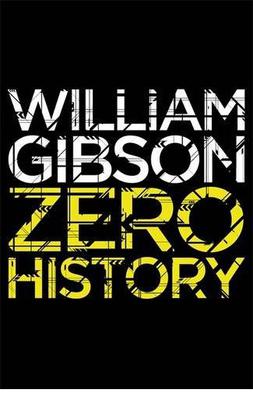
Once upon a time, I wanted to write a paper on William Gibson’s Blue Ant trilogy using one of its protagonist’s obsession with her black Buzz Rickson MA-1 jacket as its conceptual anchor. The jacket, indicative of Gibson’s interest in the materiality of his textual worlds, suggested a particular reality informed by the aesthetics of American military tailoring and Japanese reproduction of heritage Americana. The nascent idea was to investigate how Gibson’s world-building was both tied to and critiqued the pervasive market forces of global capital.
Yawn …
I was working as a literary studies academic at the time and this sort of this, described in this sort of language, seemed like the thing to do. Suffice it to say, that paper was never written. However, my love of Gibson’s work, his interest in the connections between fashion, emergent technology, military uniforms, and commercial forces, remained present, taking on a materiality of its own. Where once the overriding focus of my attention was defined by words like plot, character, tone, style, mood, PoV, symbolism, archetype, ideology, and all that scholarly jazz, it was now peppered with an altogether different lexicon. Selvedge, waxed canvas, duck canvas, Norwegian storm welt, sashiko, hidden rivets, kakishibu, button down, rope-dyed, broguing, veg-tanned leather, work shirt, chain stitching, pleats, patch pockets, and nep entered everyday use.
Another consequence was a lot of reading about fashion. Articles were found and printed out, read, highlighted in neon yellow, and then crammed onto a shelf. Ignored. Almost-but-not-quite forgotten.
In “So Last Season: The Production of the Fashion Present in the Politics of Time”, Aurelie Van de Peer argues for an understanding of fashion a cultural practice involved in a distinct politics of time which imposes, through the sartorial choices of its wearers, a certain backwardness or forwardness upon the present. In other words, based on what you wear, one can be “in” or “out” or “soooooo last season” or “ahead of the curve”. After the expression of judgemental exchange with a “fashion forward” friend, Van de Peer considers the different realties we occupy based on outfit choices alone:
“Surely my friend and I were in the same chronological present or clock-measured moment in time. Likewise, we sat on the same restaurant’s terrace on the same chilly spring evening with the sun just set. Seen through the lens of the physical on natural time, no one would deny that my friend and I were physically simultaneous to each other. Yet my choice of dress was not deemed contemporary or distinctively representative of the fashion present.”1
Apologies for getting all academic, but something extremely cool is being argued for here.
- Fashion can act as a cultural time machine recalling previous moments through the choice of this or that cut, silhouette, material, pattern, accessory, etc.
- Fashion produces distinct realties that are opposed to, compliant with, driven by, derived from, and/or contiguous with one another.
- Fashion is not unlike a story whose interaction with society and the world is potent as it is complex insofar as two people sitting across from one another in a restaurant can be seen and felt to be occupying, if not invoking, two different realities.
Now, this is where those of us who obsess over the details of sanforised, 15.7oz, 100% Zimbabwe cotton, GTB stripes, custom engraved buttons, raised belt loops, peek-a-boo selvedge coin pocket jeans can really geek out because wearing our pair of Momotaros isn’t simply amazing, it is, for lack of a better word, a kind of spell whose parameters are both external and internal.
Let’s return to Gibson for a moment to help explain this magic. In the opening chapters of Pattern Recognition (2003), Cayce Pollard, explains just why it is she not only bought the Buzz Rickson MA-1, but wears it as an expression, if not extension, of her character. The description, as with many of Gibson’s rendering of material objects, conjures an entire universe of intent and labour.
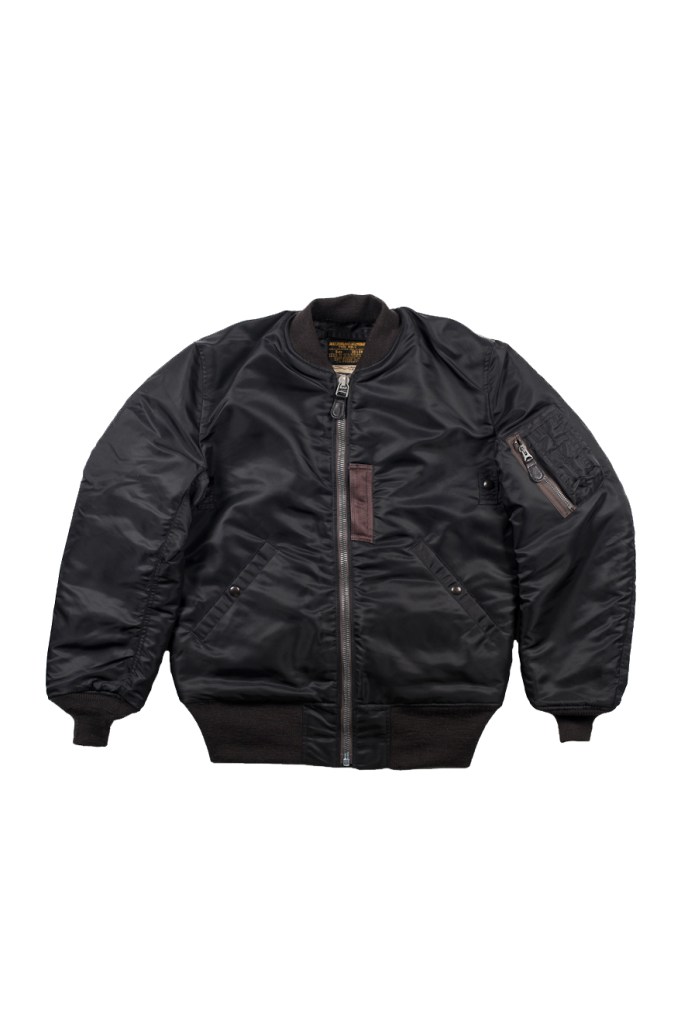
“Cayce knows […] that the characteristically wrinkled seams down either arm were originally the result of sewing with pre-war industrial machines that rebelled against the slippery new material, nylon. The makers of the Rickson’s have exaggerated this, but only very slightly, and done a hundred other things, tiny things, as well, so that their product has become […] an act of worship. It is an imitation more real somehow than that which it emulates.”2
Cayce sees something sacred in the jacket; there is an aspect of its construction, its care and exactitude, which suggests an act of devotion on the part of its makers. This devotion, though, carries over onto its wearer. For Cayce, the jacket, in the perfection of its details, its relationship to history, is somehow distinct, if not divorced, from the regular production of fashion to which she is aggressively allergic. Wearing it, therefore, is an act of stylistic iconoclasm that declares: I know what is good and right and cool and, most importantly, authentic within a world framed by fast-fashion with its continual watering down of true and proper design. It tells us something about Cayce and her world (and worldview). Through wearing it she makes value judgements about the style she encounters throughout the text, identifying her with her job as a “cool hunter” and manifesting as something like her externalised soul. In a very real sense, she is the jacket and the jacket is her. When it is damaged by a rival, more than the garment is ruined. Cayce is damaged, and it is not until she finds a replacement that this damaged is corrected.
Now we don’t really have to rehash Polonius’ famous line “Apparel oft proclaims the man”3 to understand why this is so. Putting aside the potential fetishisation within Cayce’s description, her MA-1 jacket is the crystallisation of a set of choices, the full vision of which produce a clear picture of what she values, how she values it, how she comports herself, how she sees herself, how she comprehends her work, and how she engages with her world and its various economies. And does this not correspond with Van de Peer’s basic premise that fashion — be it fast or high — is a constructor of realities, a conjurer of temporalities? In both case, Gibson and Van de Peer are fascinated in the world-building afforded not simply by clothing in and of itself, but through the individual’s wearing of said clothing. Their choice to wear this or that piece of clothing.
Take the jeans alluded to before and pictured below.
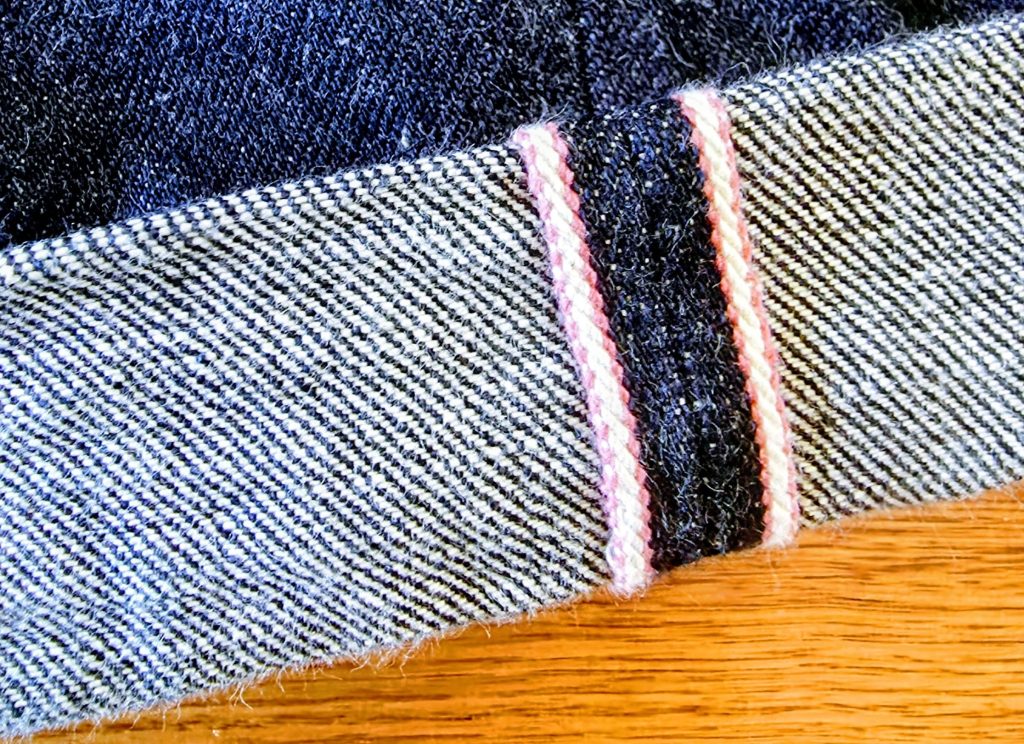
Momotaro 0405 High Tapered with pink selvedge ID
On the surface, they a jeans, not unlike any other pair of jeans. They are made of cotton. They warp yarns are dyed with indigo. They follow a basic five-pocket pattern set down decades ago. They look good with both sneaker and boot. You know, jeans. Like so many things, though, the details tell a different story. The denim is heavy and textured, its cotton sourced from Africa. The hardware is silver-coated copper engraved with the brands peach logo. The belt loops are roped, recalling a heritage of vintage shuttle looms and bomb-proof construction. The selvedge ID is pink.
This final point is key. I like cuffing my trousers. If they can be cuffed, I cuff them. While I do this for practical reasons (my legs are often shorter than inseams), I also cuff because I think it looks good. I believe it suits me and the image of me constructed through my clothing. The selvedge ID identifies the jeans as Momotaro jeans. Consequently, those who know the brand or the selvedge denim milieu place me within a reality framed by names like Japan Blue, Fullcount, Big John, Tanuki, Pure Blue Japan, and Samurai. Thus, they are not simply jeans, they are a portal to a world built with a specific and particular perception of warp and weft.
Warp.
Weft.
Weaving.
Isn’t it compelling that the language of textiles overlaps with the grammar of storytelling? Narrative threads are woven together by a writer. Characters are given texture by the fabric of motivation, trauma, values, goals, and ideology. Like a complex garment, whole worlds are constructed with different topographical dyes, socio-political stitching, moral measurements, and genre silhouettes. Quickly glance at the web listing for a product and you’ll quickly discern a story in manufacturing details, brand marketing, and industry history. And whether you are rationalise the asking price with this narrative, it is inescapably true that to wear anything is to enter into a story, a world, a reality that has been and is still being woven around, with, and through you.
Moreover, it is a function of clothing that changes as a result of wear. You wear in a pair of leather shoes. You wear out the elbows of a shirt. Necklines are stretched. Laundering shrinks. Dyes fades. Crotch blowout is a thing. That, and crocking. Blood and sweat and dirt and wine and cigarette smoke and oil seeps into the fibre, staining it, but those stains aren’t signs of an object ruined. Rather, they are markers of the life lived within their stiches. They become a tangible map of nights out and international trips, hours on public transport, conversations shared with friends, bad dates, a first kiss, scars, victories, Christmases, birthdays, and trips to the shops.
We live in our clothes.
Our stories become their stories; their stories validate, challenge, underscore, add to, inform, subvert, and/or alter our own.
What I hope will follow this first post is an exploration of my textile story and the important chapters (i.e. pieces of menswear) threaded through it.
- Van de Peer, A 2015, “So Last Season: The Production of the Fashion Present in the Politics of Time”, Fashion Theory, 18:3, 319 ↩︎
- Gibson, W 2003 (2011), Pattern Recognition, Penguin Books, London, 11 ↩︎
- Hamlet 1.3.78 ↩︎


 Narrative Gauge Sweater
Leave a reply to Daniel Baker Cancel reply